The best speakers for a small room are a compact stereo pair, placed with care and chosen for control rather than sheer size. A small room cannot use a huge speaker’s extra output, and big bass in a tight space tends to boom rather than impress. Get two bookshelf-sized speakers in the right spots, with your seat the right distance away, and a small room can sound excellent.
Why do small rooms need different speakers?
Every room shapes what you hear, and a small one shapes it more. The walls are close, so sound bounces back to you almost immediately and blends with what the speakers are producing. Bass is the biggest problem. Low notes have long wavelengths, and in a small room they pile up in some places and fade in others. The result is bass that sounds heavy and one-note at one end of the sofa and thin at the other.
This is why a bigger speaker is not automatically a better choice. A large speaker pushes out more low-frequency energy than a small room can handle, and the room answers with boom. A smaller speaker that is well balanced often sounds cleaner and more detailed, because it gives the room less to fight with.
What size speakers do you need for a small room?
Bookshelf or compact speakers are the right starting point for most small rooms: a bedroom, a study, a box room or a compact living room. They are easy to place, they do not overload the space with bass, and a good pair is more than loud enough for a room that size.
Floorstanding speakers can work, but they are harder to get right. They are usually designed with larger rooms in mind, they need more space around them, and the extra bass they produce is the very thing that causes trouble in a small space. If you love a particular floorstanding speaker, audition it in a room like yours before you commit.
There is no exact formula that matches speaker size to room size, and anyone offering one is simplifying. Treat these as a guide:
A bedroom or study: compact bookshelf speakers, listening fairly close.
A small living room: compact or mid-sized bookshelf speakers, with enough space to put them clear of the walls.
An open-plan space that feels small because it is cluttered: the same approach, with extra attention to where the sofa and the speakers sit.
Do you need a lot of power?
No. The power figure on the box matters far less in a small room than people expect. Most listening in a home happens at modest volumes, and a small room fills with sound quickly. A pair of speakers with a sensible amount of clean power will be loud enough long before you reach their limit.
What does matter is that the power figure is honest. Look for RMS watts, which describe the power a speaker can deliver continuously, rather than peak figures that describe a brief burst. If you want the full explanation, our guide to powered vs passive speakers covers how the amplifier and speaker work together.
Are powered speakers better for small rooms?
Often, yes, for practical rather than acoustic reasons. Powered speakers have the amplifier built in, so there is no separate amplifier box to find room for, and fewer cables to hide. In a small room where every shelf is spoken for, that matters.
Wireless pairs go a step further. When the left and right speakers talk to each other without a cable, you can put each one exactly where it sounds best, instead of where a cable happens to reach. That freedom is valuable in a small room, where the best position is often only a few centimetres from the awkward one.
How should you set up speakers in a small room?
Placement does more for a small room than any purchase. These steps cost nothing.
Pull the speakers away from the walls. Speakers pushed hard against the wall behind them, or into a corner, produce heavier and less even bass. Even 20 to 30cm of gap helps. Our guide to how far from the wall bookshelf speakers should be goes through it.
Keep them away from the corners. A corner exaggerates bass more than any other spot in the room.
Put the tweeters at ear height when you are seated. On a low sideboard this may mean stands or a stack of books under each speaker.
Sit closer than you think. In a small room you can use the nearfield: sit at a similar distance from each speaker as they are apart, and the sound from the speakers reaches you before the room has added much of its own. That favours clarity.
Keep it symmetrical. If you can, give each speaker similar surroundings, so the left and right channels arrive in the same way.
Angle them slightly in. A small toe-in towards your seat sharpens the centre of the stereo image.
If the textbook layout will not fit, that is normal. We wrote about where to put speakers when the perfect triangle will not fit for exactly that situation, and about designing audio for smaller spaces more broadly.
How do you stop a small room sounding boomy?
Start with placement, because that is where most of the problem is. If the bass is still heavy, try these in order:
Move the speakers a little further from the wall behind them.
Move your seat. A spot with your back directly against the rear wall tends to pile up bass, so a short move forwards can help.
Add soft furnishings. A rug, curtains, a bookcase and upholstered furniture all absorb some of the sound that would otherwise bounce around.
Check any rear-facing bass port. If your speakers have one, it needs breathing space, and pushing the speaker against a wall can make the bass heavier.
You do not need acoustic panels in most homes. Normal furniture does a lot of the same job.
What about a TV in a small room?
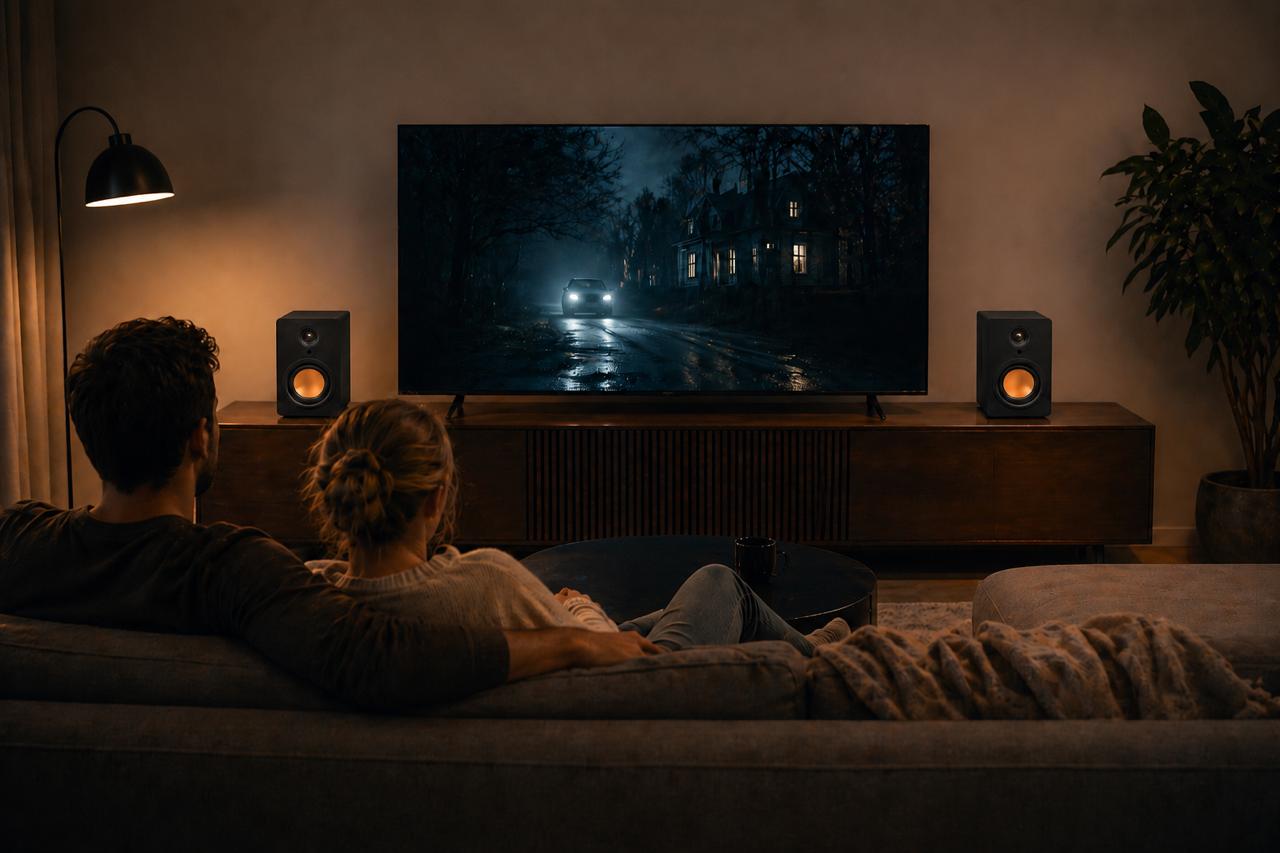
A small room is where a pair of speakers can most clearly beat a soundbar. A soundbar sits in one place and pushes sound forwards from one box. A stereo pair puts a speaker either side of the screen, which gives you a wider and more natural sound even if the speakers themselves are small. We compare the two properly in stereo vs soundbar.
If you are shopping for this, the uStream Cube is a compact pair of true wireless stereo speakers with a 106mm driver in each and 35W RMS per speaker. They connect to a TV by HDMI ARC, with no cable between the two speakers. The uStream One is the next step up at 100W RMS for the pair, and it adds an optical input as well as HDMI ARC. Both pair automatically, with no app and no Wi-Fi. You can compare the whole uStream range to see which suits your room.
Frequently asked questions
What size speakers do I need for my room?
For a small room, compact bookshelf speakers are the safest choice. Bigger speakers produce more bass than a small room can handle and tend to sound boomy. There is no precise formula, so judge by how the room sounds once the speakers are placed well, not by the size of the box.
What is the best speaker setup for a small room?
Two compact speakers in stereo, pulled away from the walls and corners, with the tweeters at ear height and your seat about as far from each speaker as they are apart. Keep the layout symmetrical and add soft furnishings if the room sounds harsh.
Can you use big speakers in a small room?
You can, but it is harder. Large speakers push out a lot of low-frequency energy, and a small room tends to turn it into boom. If you already own big speakers, move them away from walls and corners, and sit a little closer to them to reduce the room’s influence.
Do small rooms need powered speakers?
Not necessarily, but powered speakers suit them well. With the amplifier built in, you need fewer boxes and fewer cables, which helps when space is tight. Passive speakers with a separate amplifier can sound just as good if you have somewhere to put the amplifier.