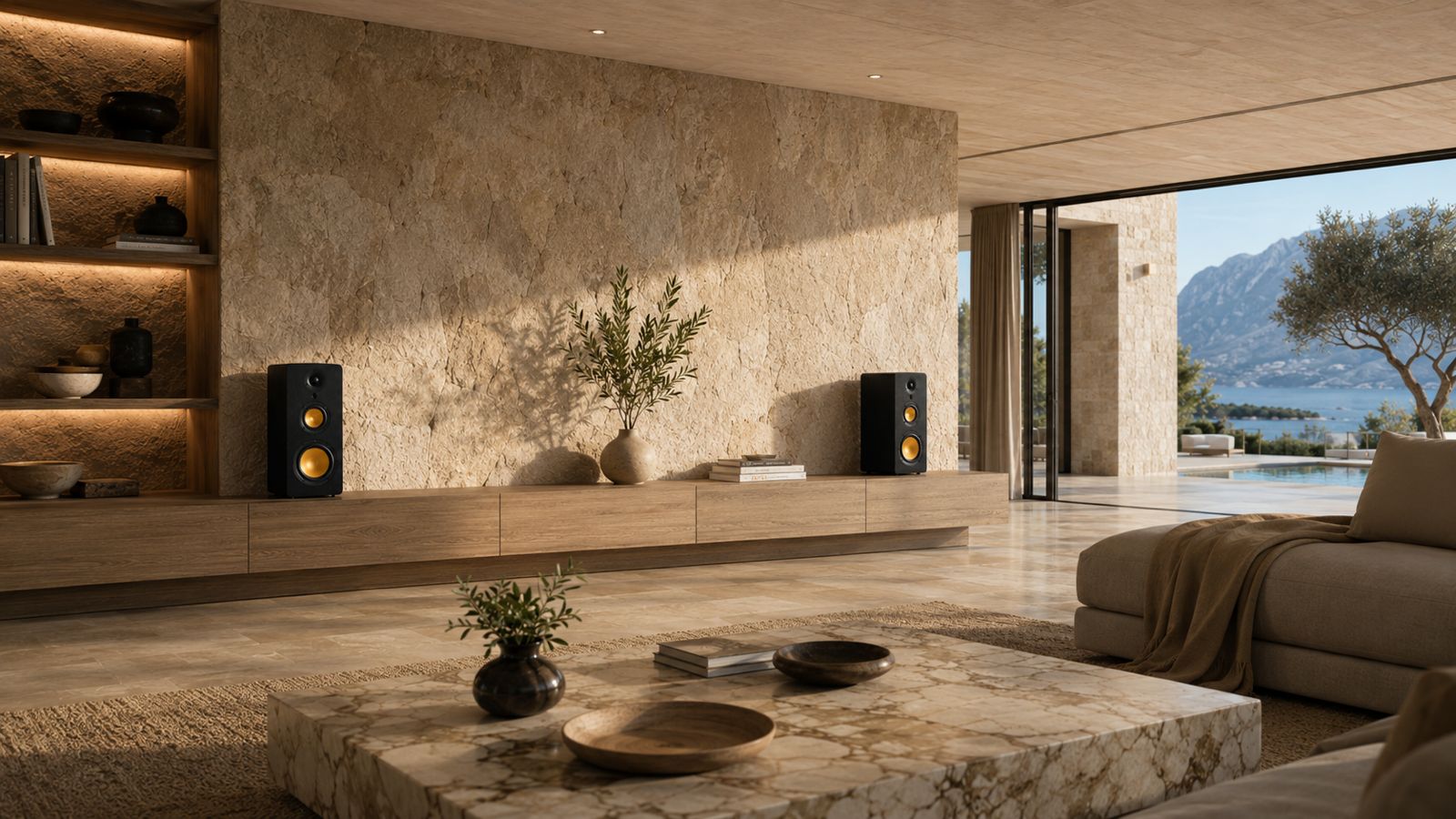
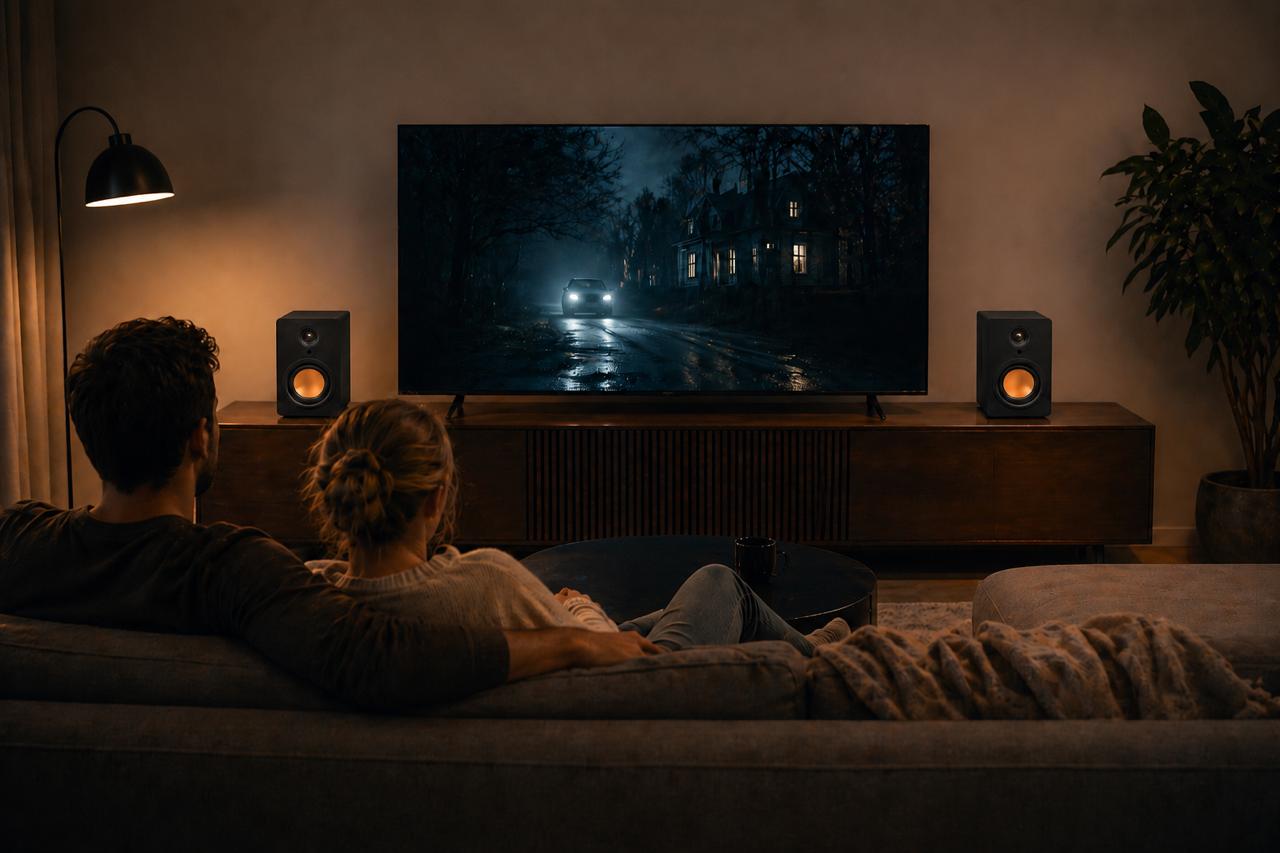
A good starting point is 20 to 50cm between the back of a bookshelf speaker and the wall behind it, and a little more from the side walls. Closer than that and the bass tends to thicken and blur; much further and it can start to sound thin. Treat that range as where you begin, not where you finish. Every room is different, and ten minutes of moving the speakers a few centimetres at a time will tell you more than any rule.
Why does distance from the wall change the sound?
A speaker doesn’t only send sound forwards. Low frequencies spread out in every direction, including backwards towards the wall behind the cabinet. That wall reflects the bass back into the room, where it combines with the sound coming straight from the speaker.
Two things happen as a result.
Bass reinforcement. The closer a speaker is to a wall, the more that reflected bass adds to the direct sound. Pushed right up against a wall, most bookshelf speakers sound fuller but also heavier and less tidy, with notes that drone on rather than stopping cleanly. In a corner, with two walls close by, the effect is stronger still.
Bass cancellation. The reflected sound arrives slightly later than the direct sound. At certain frequencies it arrives out of step and partly cancels, leaving a dip. Where that dip falls depends on the distance to the wall. With the speaker about 60cm out, for example, the reflection travels roughly 1.2 metres further, and the dip lands in the upper bass at around 140Hz, right where the body of voices, bass guitar and cello sits.
You can’t remove these effects entirely, but you can move them around and make them less obvious. That is really what speaker placement is: choosing which compromise sounds best in your room.
What is the right distance for bookshelf speakers?
There is no single number, but these starting points work in most homes.
From the wall behind: 20 to 50cm to begin with. If you have the space, try up to a metre and listen for whether the sound opens up.
From the side walls: at least as far as they are from the back wall, and ideally a bit further. Keeping the two distances different stops their bass effects stacking at the same frequency.
From each other: roughly the same as the distance from each speaker to your listening seat, so the three points form an equilateral triangle. We explain the triangle in more depth in our guide to setting up for a better centre image.
Most people end up somewhere around 30 to 40cm from the rear wall in a typical living room. That keeps the speakers out of the way while giving the bass room to breathe.
Does it matter where the bass port is?
Yes. Many bookshelf speakers have a port, a round opening that helps the cabinet produce more bass. Where it sits changes how fussy the speaker is about the wall.
Rear-ported speakers breathe out of the back. Put them too close to a wall and the port’s output gets pushed back at you, which can make the bass boomy. Give them the most space, and don’t go below the lower end of the range above unless you’ve tried it and like it.
Front-ported speakers have the opening on the front, so they are usually more tolerant of being near a wall or on a shelf.
Sealed speakers have no port at all. They generally cope best with tight spaces, though the same boundary effects still apply.
If you’re not sure what you have, look at the back of the cabinet, or check the manual. If the bass is overwhelming and you can’t move the speakers further out, many ported speakers come with foam bungs that fit in the port and tame it. Use them if you have them.
Can bookshelf speakers go on a bookshelf?
They can, and in many homes they have to. It just takes a little care.
The problem with a shelf is that the speaker sits inside a box that is open at the front. That space can resonate and colour the bass, and the edges of the shelf can reflect sound in ways that muddy the stereo image. A few simple habits reduce the damage:
Pull the speaker forward so its front is level with the front edge of the shelf, or just proud of it. Never tuck it back into the cavity.
Fill the space around and behind the speaker with books. A densely packed shelf is far better than an empty one.
Avoid a shelf with a rear-ported speaker if you have a choice. A front-ported or sealed design suits shelves better.
Keep both speakers at the same height and in matching positions, so each side of the stereo picture sounds the same.
If you can, stands are still the better option. They free the speaker from the furniture, let you set the height properly and make it easy to experiment with distance.
How high should bookshelf speakers be?
Aim for the tweeter, the small driver that handles high frequencies, to be roughly level with your ears when you’re sitting in your usual seat. For most sofas and armchairs that means a speaker stand somewhere around 60 to 70cm tall, but measure your own seated ear height rather than guessing.
If the speakers have to sit lower, on a low unit or a TV bench, angle them up slightly towards your ears. If they sit higher, on a tall shelf, tilt them down a little. Small wedges or angled pads do this neatly.
Should you angle bookshelf speakers towards you?
Usually, yes, but only a little. Angling speakers inwards, often called toe-in, points the tweeters more towards your seat. It tends to firm up the centre of the stereo image, so a vocalist sits clearly between the speakers rather than hovering around one of them.
Start with the speakers facing straight ahead, then turn them in a few degrees at a time. A common end point is where you can just see the inside edge of each cabinet from your seat. Too much toe-in can make the sound narrow and a little bright, so stop when the centre locks in.
How to find the right position by ear
Numbers get you close. Your ears finish the job. This is the simplest method we know:
Put the speakers in the starting positions above: 20 to 50cm from the back wall, further from the side walls, and in a rough triangle with your seat.
Choose a track you know well with a steady, even bass line and a clear vocal. Something acoustic is ideal, because you know how the instruments should sound.
Move both speakers back towards the wall about 5cm at a time, then forward the same way, listening from your seat each time. Keep them symmetrical.
Listen for the point where bass notes sound even and distinct: each note roughly the same weight, none booming, none vanishing.
Once the bass is right, adjust the toe-in until the vocal sits firmly in the centre.
Mark the spot with a small piece of tape on the floor or shelf, so you can put the speakers back after cleaning.
If some bass notes still boom whatever you do, the room itself may be the cause rather than the speakers. Moving your seat forward or back a short distance can help, and soft furnishings calm the rest. Our guide to listening room design covers the room side of things, and if your space is compact, designing audio for smaller spaces is worth a read.
When wireless speakers make this easier
The hardest part of good placement is often the cable. With a traditional pair, the left and right speakers are wired together or to an amplifier, so they tend to end up wherever the wire reaches rather than where they sound best.
True wireless stereo speakers take that constraint away. Our uStream Cube and uStream One are compact pairs where the left and right speakers connect to each other wirelessly and pair automatically, so moving them five centimetres at a time is easy while you find the right spot, with no wire running between them to limit where they go. You can see the full uStream range if you want to compare sizes.
Frequently asked questions
How far apart should bookshelf speakers be?
Roughly as far apart as they are from your listening seat, so the speakers and your head form an equilateral triangle. In many living rooms that works out at somewhere between 1.5 and 2.5 metres. Too close and the stereo image shrinks; too far and a gap opens up in the middle.
Can bookshelf speakers be placed against a wall?
They can, but most will sound heavier and less clear in the bass. Sealed and front-ported designs cope better than rear-ported ones. If you have no choice, fit the port bungs if they came with the speakers, and keep them out of the corners.
What happens if speakers are too far from the wall?
The bass can start to sound lighter, because the wall is no longer reinforcing it, and in a busy room the speakers may simply get in the way. If the sound seems thin, try moving them back towards the wall in small steps until the bass fills out.
Should both speakers be the same distance from the wall?
Yes. Keep both speakers the same distance from the wall behind and, as far as the room allows, from the side walls. If one speaker is much closer to a wall than the other, that side will sound bassier and the stereo image will pull towards it.