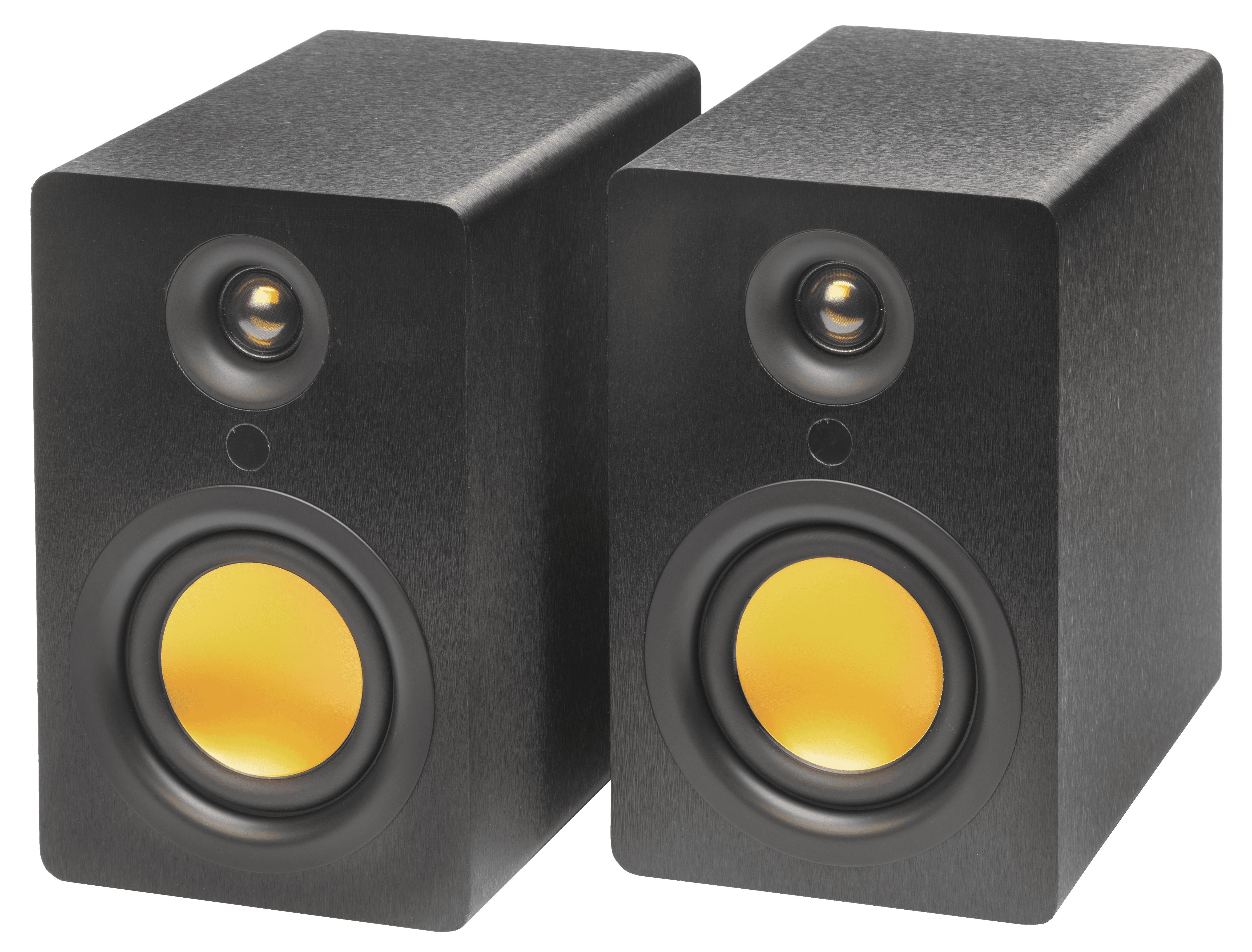

You can put bookshelf speakers in a bookshelf, but they rarely sound their best pushed to the back of a shelf. Squeezed into a cavity, most speakers pick up extra boomy bass and lose some clarity. The good news is that a few simple changes, such as bringing them to the front edge and checking where the port is, make a real difference.
What are bookshelf speakers?
The name describes a size, not a rule about where they go. Bookshelf speakers are compact speakers small enough to sit on a shelf, a sideboard, a desk or a pair of stands, as opposed to floorstanding speakers, which are tall enough to stand on the floor by themselves.
So a bookshelf speaker can go on a bookshelf, but the name does not mean it was designed to live inside one. Many sound better on stands or on top of a unit with a little space around them.
Why do speakers sound boomy inside a shelf?
A speaker does not only send sound forwards. Low frequencies spread out in all directions, including backwards and sideways. When a speaker sits in a shelf cavity, the back, sides and top of the shelf all sit close to the cabinet. Bass reflects off those surfaces and builds up, so the low end can sound heavy, loose or boomy.
Hollow shelves and thin panels can also vibrate with the music, and objects close to the speaker can buzz.
Does port position matter?
Yes, and it is one of the first things to check. Many speakers have a port, a hole or slot in the cabinet that helps the speaker produce more bass. Where that port sits changes how the speaker behaves in a tight space.
Rear-ported speakers breathe out of the back. In a shelf, the port faces the back wall of the cavity, which can make bass build up even more. These usually need space behind them.
Front-ported speakers breathe out of the front, so they tend to cope better close to a wall or inside a shelf.
Sealed speakers have no port at all, and are often the easiest to place in a tight spot.
Check the back and front of your speakers, and the user guide, before you decide where they go. Some rear-ported speakers come with foam bungs that partly block the port, which can calm the bass if you have to place them close to a surface.
How do you get bookshelf speakers to sound right in a shelf?
Bring them to the front edge. Pull the speakers forward so the front of each cabinet lines up with the front of the shelf. This reduces reflections.
Fill the gaps. Books packed loosely around the speaker, or a soft material behind it, can reduce reflections in the cavity. Leave the port clear.
Choose a solid shelf. A sturdy shelf vibrates less than a thin, hollow one. A decoupling pad under each speaker can help.
Get the height right. Aim for the tweeters to sit roughly at ear height when you are seated.
Angle them towards you. If the shelf is high or low, a small wedge or tilt can point the tweeters at your ears. A slight inward angle helps the stereo picture.
Keep them symmetrical. Try to place the left and right speakers in similar positions, so both sides sound alike.
For how much space to leave behind a speaker on a shelf or unit, our guide to how far bookshelf speakers should be from the wall covers the details. Our article on where speakers should be placed covers the wider picture.
What about speakers inside a TV cabinet?
The same rules apply, often more strongly, because a TV cabinet is usually deeper and more enclosed than a bookshelf. If the speakers have to go inside, bring them to the front, leave any door open or remove it, and keep the port clear. Placing them either side of the screen on top of the unit is usually better. If you are working with a small room, our guide to designing audio for smaller spaces has more ideas.
Where does the uStream Cube fit?
The uStream Cube is a compact pair with a flush-fitted cone. The two speakers link automatically with no app and no Wi-Fi, and there is no cable between them, so you can place each one where it suits the room. It connects to a TV through HDMI eARC, and the TV remote then controls the volume.
Frequently asked questions
What is the definition of a bookshelf speaker?
It is a compact speaker small enough for a shelf, desk or stand, as opposed to a tall floorstanding speaker. The name describes the size, not where it must go.
Can I put bookshelf speakers in a cabinet?
You can, but bring them to the front edge, keep any port clear and leave doors open. Enclosed spaces tend to make bass sound boomy.
Are front-ported speakers better for a bookshelf?
They tend to cope better in a shelf than rear-ported speakers, because the port is not facing the back of the cavity. Sealed speakers are also a good choice.
Should bookshelf speakers be on stands?
Not always, but stands often help. They raise the tweeters towards ear height and free the speakers from walls and shelves.
Follow Mitchell Acoustics on Facebook, Instagram, YouTube, X, Threads, Pinterest, LinkedIn and TikTok for new uStream guides, setup films and listening tips.