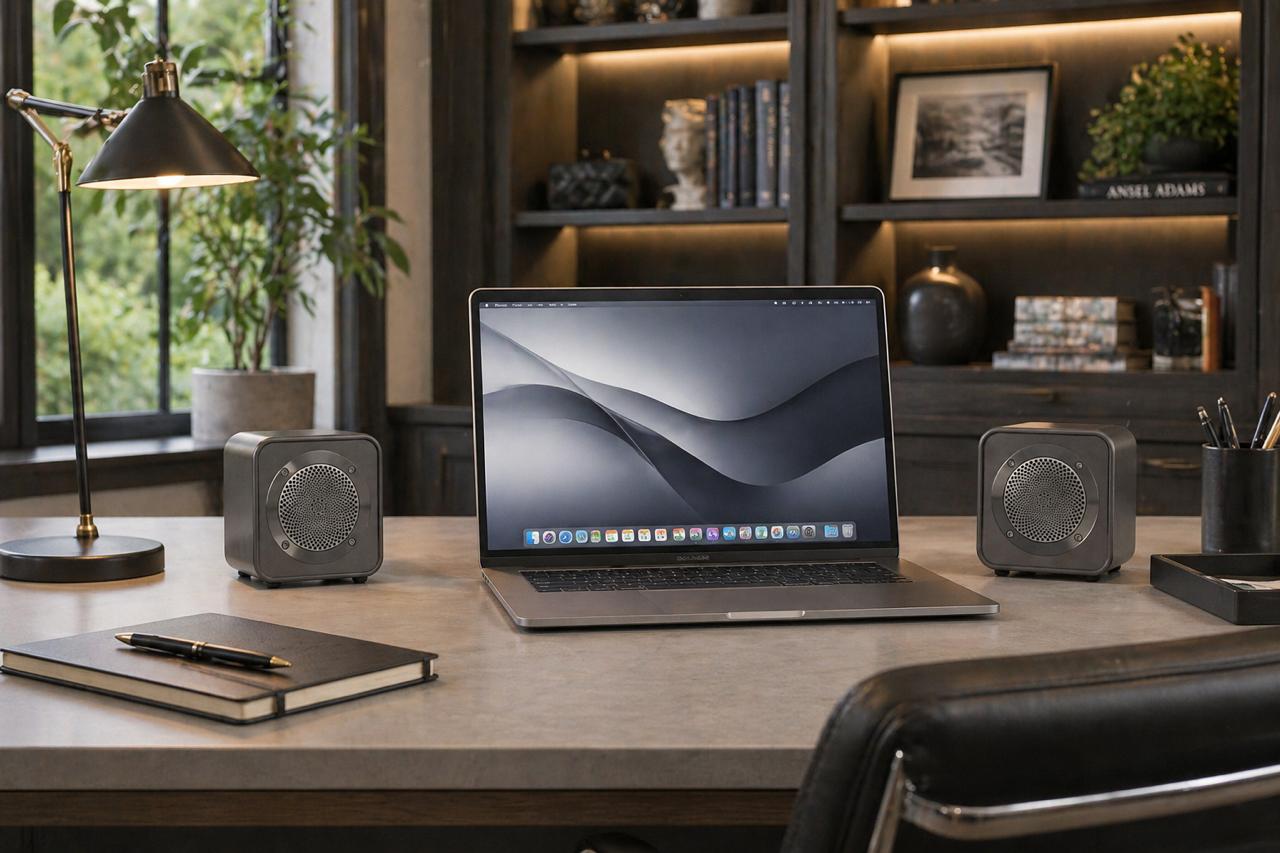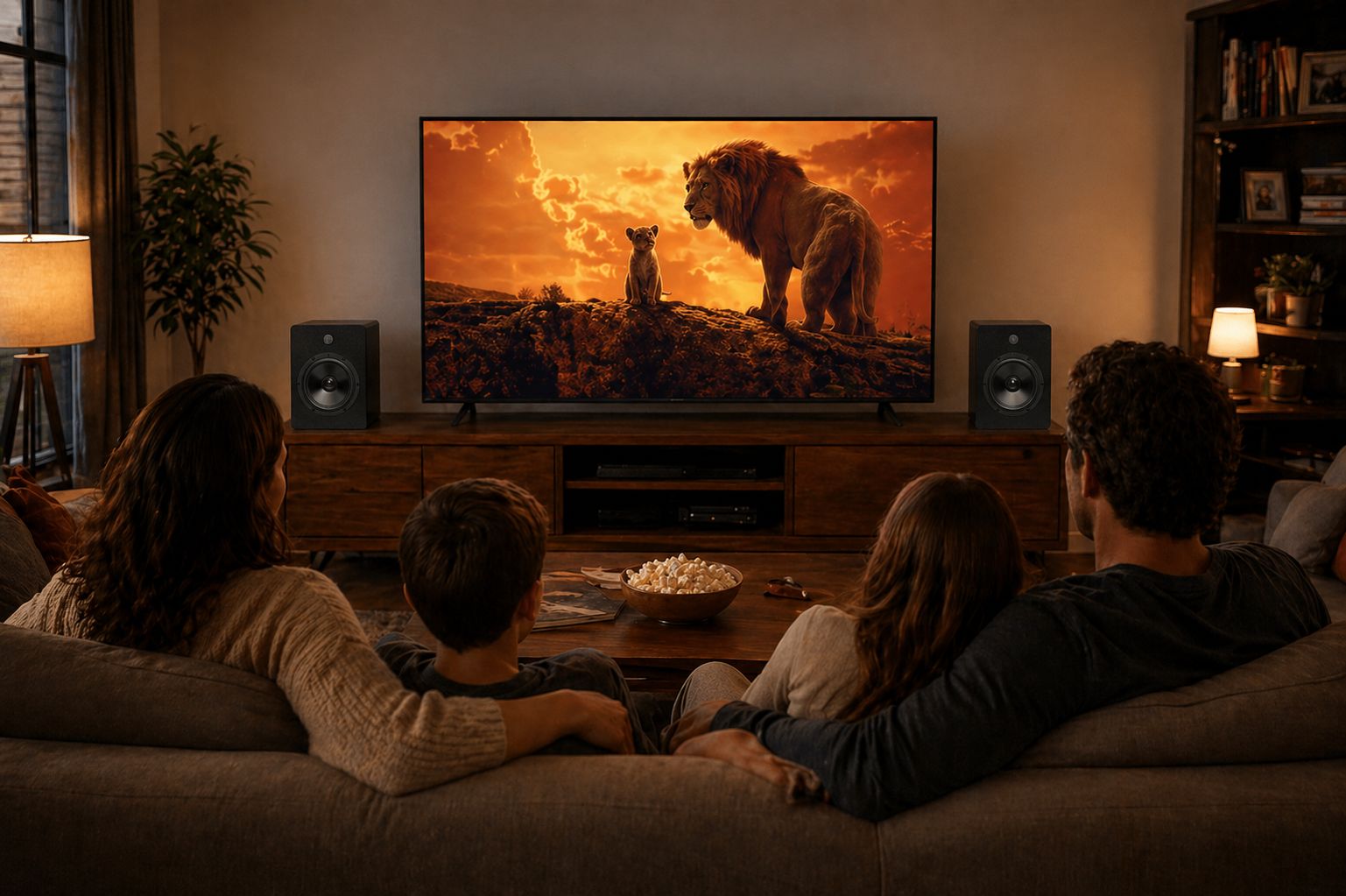
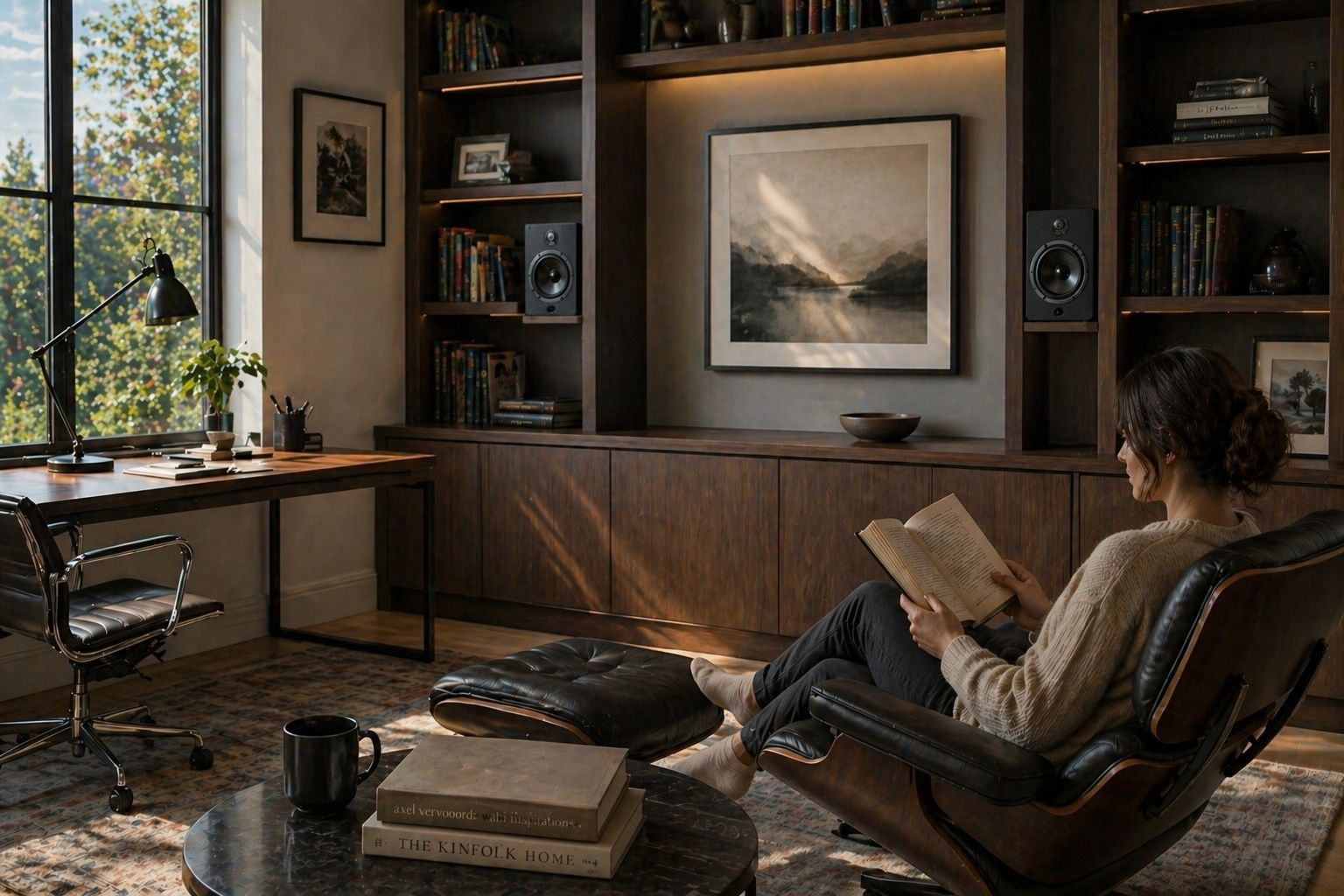
Speakers should be placed so that both are the same distance from where you usually sit, with the tweeters roughly at ear height and the cabinets out of the corners. Those three things matter more than hitting a perfect equilateral triangle. If your room lets you build the full textbook setup, do it. If it doesn’t, get the priorities right and you’ll still hear proper stereo.
Does speaker placement really matter?
Yes, and more than most people expect. The same pair of speakers can sound boomy and vague in one spot and tight and focused a metre away. Position changes how much bass the walls add, whether the stereo image holds together in the middle, and how much of the sound reaches you directly rather than bouncing off nearby surfaces first.
It is also the cheapest upgrade in audio: moving speakers costs nothing.
The ideal layout is well known: the two speakers and your head form an equilateral triangle, the speakers are angled slightly towards you, and everything is symmetrical. We explain that properly in our guide to getting a solid centre image. This article is about what to do when real furniture, doors, windows and family life get in the way.
What should you get right first?
When you can’t have everything, work down this list and stop compromising as late as possible.
Equal distance to your seat. If one speaker is noticeably closer to you than the other, its sound reaches you first and your brain pulls the whole stereo image towards it. Voices that should sit in the middle drift to one side. Of everything on this list, this is the one to protect.
Tweeters near ear height. High frequencies are the most directional part of the sound. A tweeter pointing at your knees or over your head loses detail and focus.
Out of the corners. A speaker tucked into a corner gets its bass reinforced by two walls and the floor at once. The result is usually heavy, droning bass that masks everything else.
Clear line of sight. A sofa arm, a plant or the side of a TV cabinet between the speaker and your ears softens the treble and blurs the image.
The triangle itself. The speakers can be a little closer together or further apart than the textbook 60 degrees and still sound good, as long as the first four points hold.
Where should speakers go if your sofa is against the back wall?
This is the most common living room layout, and it is not ideal. Sitting with your head close to a wall means you hear a strong reflection from right behind you, and the bass builds up there too. Many people find their sofa is the boomiest seat in the room.
If you can pull the sofa forward even 30 or 40cm, try it. The improvement in bass clarity is often obvious straight away.
If the sofa has to stay put:
Keep the speakers well away from the wall in front of you, so you aren’t stacking bass at both ends of the room.
Bring the speakers slightly closer together than the full triangle would suggest. A narrower spread with a bit more toe-in keeps the centre image firm when the room is working against you.
A thick throw, cushions or a soft wall hanging behind the sofa takes the edge off that rear reflection.
How do you place speakers if your seat is off-centre?
Lots of rooms put the main seat to one side: an L-shaped sofa, a chair by the window, a door in the middle of the speaker wall.
The key idea is that speakers should be centred on the listener, not on the wall or the furniture. If your usual seat is a metre left of the room’s centre line, shift the pair a metre left as well. It can look slightly odd at first, but the sound will be much better than a perfectly symmetrical arrangement aimed at an empty space.
When you genuinely can’t move the speakers:
Angle the nearer speaker a little away from you and the further one more directly at you. The far speaker then sounds slightly louder and brighter from your seat, which helps balance the difference in distance.
As a last resort, a small adjustment to the balance control on your amplifier or app can nudge the image back towards the middle. Moving the speakers is always better, but a small tweak is better than living with vocals stuck to one side.
What is off-axis speaker placement, and what about more than one listener?
“On-axis” means sitting directly in front of a driver, in the line it points along. “Off-axis” means listening from an angle to one side of that line. Bass spreads out fairly evenly in all directions, but treble becomes more directional as frequency rises, so the further off-axis you sit, the duller and less detailed the top end tends to sound.
That matters most when several people share a sofa. Only one seat can be the perfect spot, but you can make the others better:
Cross the axes in front of the sofa. Instead of aiming each speaker straight at the centre seat, angle them so their lines cross a little in front of it. Each speaker then points more towards the listener on the opposite side, which helps balance the timing and level differences for people sitting off-centre.
Don’t go too wide. A very wide spread gives a big image at the centre seat but leaves people at the ends much closer to one speaker than the other. A slightly narrower pair suits a group better.
Keep the speakers at seated ear height. Raising them too high puts everyone off-axis vertically as well.
Where should speakers go in a kitchen or open-plan room?
Kitchens and open-plan spaces change the goal. You are rarely sitting still in one spot, so you are aiming for even, clear sound across the area where you spend most of your time, rather than a pin-sharp stereo image.
Pick the working zone. Point the pair at the part of the room you actually use, such as the worktop or the dining table, not at the middle of the whole floor.
Use one wall or one run of worktop. Placing both speakers along the same surface, a sensible distance apart, keeps left and right roughly balanced as you move about.
Keep them away from heat, steam and water. Don’t put speakers next to a hob, over a kettle or beside the sink. Steam, splashes and grease are bad news for any electronics.
Avoid hard corners and under-cabinet gaps. Kitchens are full of hard, reflective surfaces. Tucking a speaker into a corner or under a wall cupboard adds boom and harshness.
Moderate volume carries further than you think. Hard surfaces reflect a lot of sound, so a kitchen often needs less volume than a living room of the same size.
This is where wireless pairs make life easier. A portable stereo pair such as our uStream Go runs on rechargeable batteries, lasting 30+ hours per charge, and the two speakers can sit up to 15 feet apart with no cable between them, so you can set left and right either side of a worktop without a socket or a wire in the way.
What about long, narrow rooms?
In a long room, put the speakers on one of the short walls so they play down the length of the room. That gives you space to sit at a sensible distance and keeps the side walls roughly the same distance from each speaker, which helps symmetry.
Avoid sitting exactly halfway along the room’s length or with your back pressed against the far wall. Both spots tend to be where bass is at its least even. Sitting somewhere between those two points usually gives a smoother result. If a few bass notes still boom, moving your seat forwards or backwards by 20 or 30cm is often more effective than moving the speakers.
A quick checklist for any room
Measure from each speaker to your seat. Get the two distances as close to equal as you can.
Raise or tilt the speakers so the tweeters point roughly at your ears.
Keep the speakers out of corners and give them some space from the wall behind. Our article on how far bookshelf speakers should be from the wall has starting distances.
Clear the path between the speakers and your ears.
Play a well-recorded vocal and listen for whether the voice sits in the middle. If it doesn’t, check the distances again before anything else.
Traditional speaker cable is often what decides where speakers end up, because they go wherever the wire reaches. True wireless stereo pairs such as the uStream Cube connect left to right wirelessly, with no cable between the two speakers, so it’s easier to move them into the spot that actually sounds right. You can compare the full uStream range if you’re choosing for a particular room.
Frequently asked questions
Where should speakers be placed in a living room?
Either side of the TV or main focal point, the same distance from your usual seat, with the tweeters roughly at seated ear height and the cabinets out of the corners. If the room allows, aim for the speakers to be about as far apart as they are from you, then adjust by ear.
What is the best listening position?
Somewhere along the centre line between the two speakers, ideally not right against the back wall and not exactly halfway down the room. Small moves of your seat forwards or backwards can even out the bass noticeably, so try a few spots before settling.
Does speaker placement matter for TV sound?
Yes. Dialogue sounds clearest when both speakers are the same distance from you, so the voice anchors to the centre of the screen. Place one speaker either side of the TV, level with it and outside the edges of the screen, and avoid hiding them inside a cabinet. Our page on stereo vs soundbar explains why a separated pair helps here.
Should speakers face straight ahead or point at you?
For a single listener, a slight angle towards your seat usually firms up the centre image. For several people on a sofa, less angle, or crossing the speakers’ aim a little in front of the seats, tends to spread the sound more evenly.