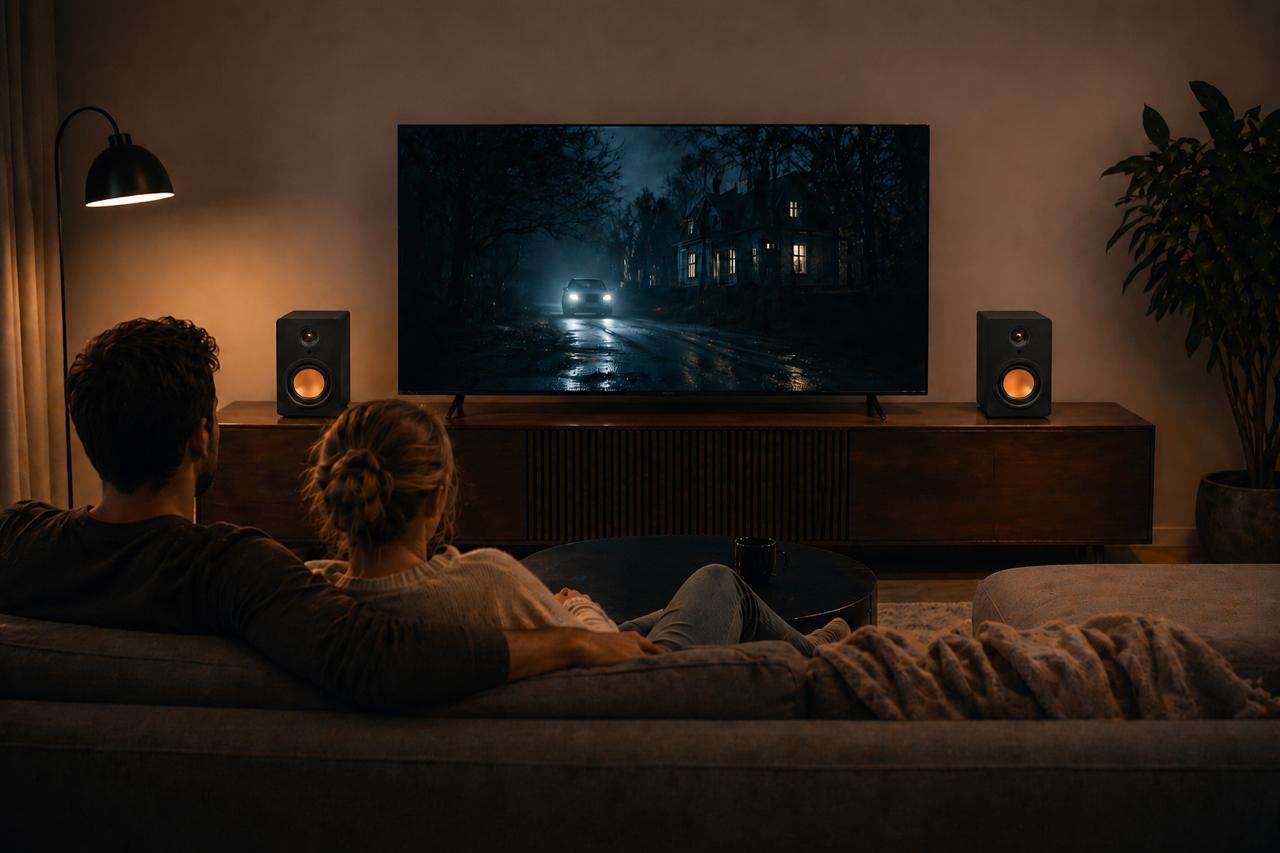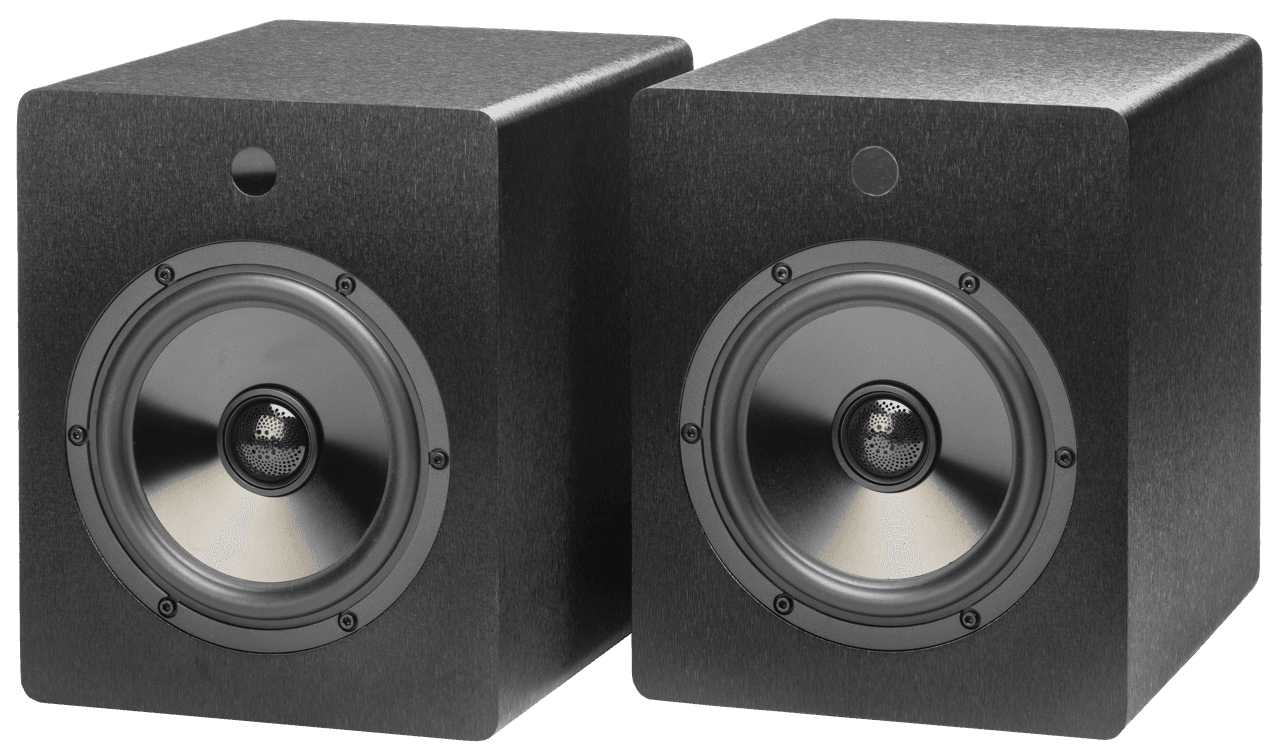
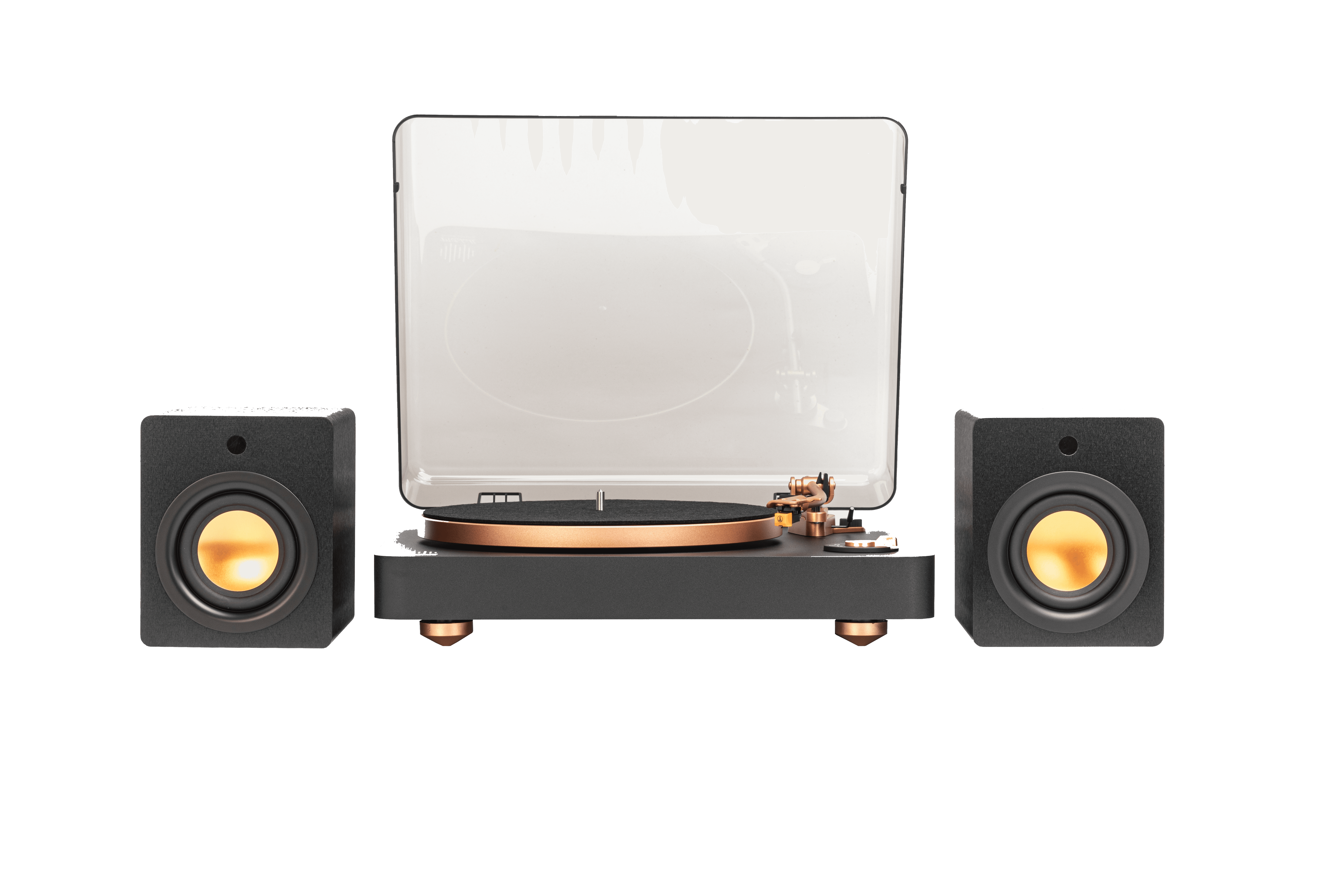
For most living rooms, the best speakers are a powered stereo pair: two speakers with the amplifier built in, sized to your room and placed either side of the TV or your seat. It handles films and music equally well, and it sounds fuller and clearer than the small speakers built into a TV. The rest of this guide helps you pick the right size and put them in the right place.
Why does a stereo pair suit a living room?
A living room does several jobs. It is where you watch TV, play music in the background and sometimes sit down to listen properly. A stereo pair covers all three, because music is mixed in stereo and film soundtracks put voices and effects across the front of the room.
Two speakers also give you a clear centre. When both play the same voice at the same level, it appears to come from the middle of the picture, which makes dialogue easier to follow. If you are weighing this against a soundbar, our guide to stereo against a soundbar explains where a pair gains.
How big should living room speakers be?
Match the speaker to the room, not to the biggest number on the box. A typical living room, with a sofa a few steps back, is well served by a good bookshelf pair. A large or open-plan room asks for bigger drivers and more continuous power, so bass and voices stay relaxed at a distance.
Small living room: compact speakers are enough. You will rarely need much volume, and large cabinets can make bass boom against close walls.
Medium living room: a two-way bookshelf pair with a sensible woofer and enough power to play at your normal level with plenty in reserve.
Large or open-plan room: larger drivers, bigger cabinets and more RMS power, or a three-way design.
Our guide to what size speakers you need for your room goes into drivers, cabinets and power in detail, and choosing speakers for a small room covers the compact end.
What should you look for in a living room speaker?
Four things matter more than the rest.
Built-in amplification. Powered speakers need no separate amplifier, which keeps the living room tidy. Our guide to powered against passive speakers explains the trade-off.
A TV connection. HDMI ARC is the best way to connect speakers to a TV, with optical as the fallback. Check the back of your TV before you buy.
RMS power. RMS is the continuous output a speaker can sustain without distorting. It is the number to compare. Our RMS power explainer shows why.
Bluetooth for music. Streaming from a phone to the same pair means one set of speakers does everything.
How should you place speakers in a living room?
Placement is worth more than a small step up in price. A well placed medium pair will beat a larger pair pushed into the corners.
Put one speaker either side of the TV, the same distance from it, with the tweeters near ear height when you are seated.
Keep both speakers roughly the same distance from your seat and turn them slightly towards you.
Leave some space behind each speaker rather than pushing it against the wall, which keeps bass tight instead of boomy.
If your sofa sits off to one side or the room is an awkward shape, our guide to where speakers should be placed covers the compromises that work.
How do you connect speakers to a living room TV?
Connect by HDMI ARC if your TV has it. One cable carries the sound, and the TV remote usually controls the volume. Optical works if there is no ARC port. Our article on the best kind of speakers for a TV compares every option.
Which uStream speakers suit a living room?
The uStream range covers most living rooms. uStream Cube is rated at 70W RMS and has no cable between its two speakers. uStream One is rated at 100W RMS and connects to a TV by HDMI eARC or optical. uStream Two is rated at 160W RMS, 80W per channel, and fills a large room without effort. uStream Three is the flagship at 240W RMS. The uStream One, uStream Two and uStream Three pairs link automatically, with no app and no Wi-Fi. You can compare them on our uStream products page.
Frequently asked questions
What are the best speakers for a living room TV?
A powered stereo pair with an HDMI ARC input, placed either side of the screen. It is easier to set up than a surround kit and gives clearer dialogue than the TV on its own.
What are the best speakers for living room music?
The same stereo pair. Music is recorded in stereo, so two speakers placed well, with a clear gap behind them and tweeters near ear height, give the widest and most natural sound.
Are Bluetooth speakers good enough for a living room?
Yes, if they are a stereo pair with enough RMS power for the room. A single small Bluetooth speaker works for casual listening, but two speakers give you proper left and right.
How many speakers do you need for a living room?
Two. A stereo pair is enough for most living rooms. Adding more brings extra wires and set-up work, and rarely improves the sound for everyday TV and music.
Follow Mitchell Acoustics on Facebook, Instagram, YouTube, X, Threads, Pinterest, LinkedIn and TikTok for new uStream guides, setup films and listening tips.