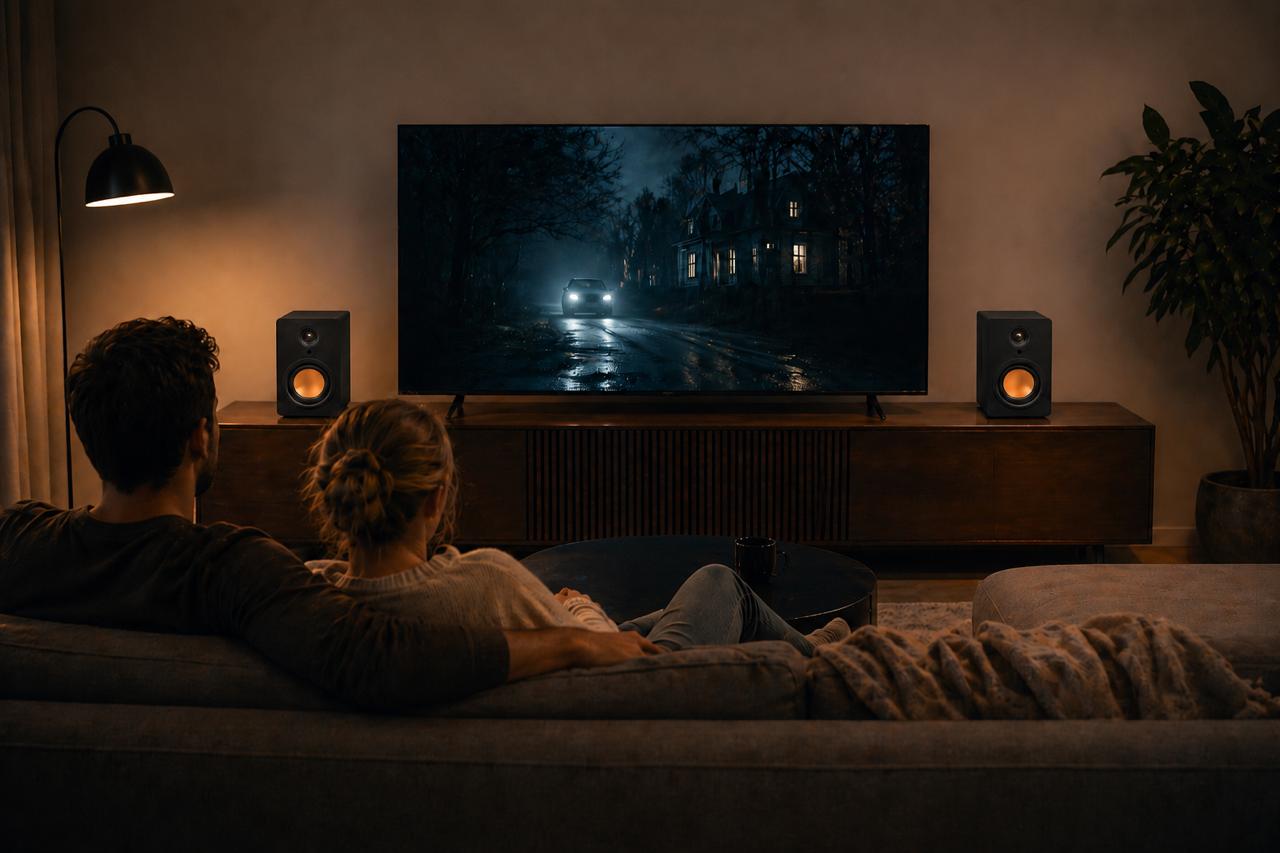
Powered speakers have their amplifier built into the cabinet, so you plug them into the mains and connect a source directly. Passive speakers have no amplifier inside and need a separate amplifier or receiver to drive them. If you’re starting from scratch and want good stereo with the fewest boxes, powered speakers are usually the better choice. If you already own an amplifier you like, or you want to upgrade one piece at a time, passive speakers make more sense.
What is the difference between powered and passive speakers?
Every speaker needs an amplifier. A source such as a phone, a TV or a turntable produces a small signal that can’t move a speaker cone on its own. The amplifier turns that small signal into enough power to drive the speaker. The only real question is where that amplifier lives.
Passive speakers contain the drivers (the woofer and tweeter), the cabinet and a crossover, but no amplifier. They connect to an external amplifier with speaker wire, and they don’t need a mains plug.
Powered speakers put the amplifier inside the speaker. Each one needs mains power, and you feed it a line-level signal, Bluetooth, or a digital connection such as optical or HDMI ARC, depending on the model.
That’s the whole distinction. Everything else, from cost to sound to how many cables you end up with, follows from it.
Are active and powered speakers the same thing?
In everyday use, yes. Shops and reviews use “active” and “powered” interchangeably, and that’s fine for buying decisions.
Strictly speaking, some engineers draw a finer line, and it’s worth knowing because it explains why some powered speakers are better engineered than others. It comes down to the crossover, the circuit that splits the music so bass goes to the woofer and treble goes to the tweeter.
In a passive speaker, the crossover sits after the amplifier. One amplifier channel drives the whole speaker, and the crossover divides that full-power signal between the drivers.
In a simple powered speaker, the arrangement is the same, just with the amplifier moved inside the box.
In a fully active design, the signal is split before amplification, and each driver gets its own amplifier. The tweeter’s amplifier only ever handles treble and the woofer’s only handles bass.
Giving each driver its own amplifier means the designer can match the amplifier to the job, and the drivers don’t have to share power through a crossover sitting between them. Whether you can hear the difference depends on the speaker and the room, but it is one reason well-designed active speakers can be very precise for their size.
Which is better, powered or passive speakers?
Neither is better across the board. The right choice depends on what you already own, how much space you have and how you like to listen.
The case for powered speakers
Fewer boxes. No separate amplifier, no rack, no speaker wire running from a cabinet to each speaker.
A matched system. The manufacturer chose the amplifier for those exact drivers, so you never end up with an amplifier that struggles with your speakers or one that’s far more powerful than they can handle.
Modern inputs built in. Many powered speakers include Bluetooth, optical and HDMI ARC, so they connect straight to a TV or phone.
Easier placement. Without a central amplifier, you aren’t tied to wherever the box and its wires can reach.
The trade-offs are that each speaker needs a mains socket nearby, and the amplifier is fixed. If you want a different sound later, you replace the speakers rather than swapping one component.
The case for passive speakers
Freedom to mix and match. You choose the amplifier and speakers separately, and can upgrade either later.
Longevity. A passive speaker has very little electronics inside, so a well-made pair can outlast several amplifiers.
One central hub. An amplifier or AV receiver can switch between many sources and, in a receiver’s case, drive more than two speakers for surround sound.
No mains lead at each speaker. Only the amplifier needs power.
The trade-offs are more equipment, more cable and more decisions. You need to match the amplifier’s power and the speakers’ impedance sensibly, and the amplifier takes up its own space.
Do active or passive speakers sound better?
Sound quality depends far more on the design and build of a particular speaker, and on where you put it, than on whether the amplifier is inside or outside. A great passive pair on a good amplifier will beat a poor powered pair, and the reverse is just as true.
What powered speakers do guarantee is a sensible match. The designer knows exactly which amplifier is driving which driver, and can tune the whole system together. With passive speakers, the result depends partly on the amplifier you pair them with, which is both the appeal (you can fine-tune the sound) and the risk (you can get it wrong).
Whichever you choose, placement does more for the sound than almost anything else. Our guide to how far bookshelf speakers should be from the wall covers the changes that cost nothing and make the biggest difference.
Are powered speakers cheaper than passive?
It depends on what you compare. A pair of passive speakers on its own is often cheaper than a similar pair of powered speakers, because there is no amplifier inside. But passive speakers can’t make a sound without an amplifier, so the fair comparison is passive speakers plus an amplifier and cable against a pair of powered speakers.
On that basis, powered speakers are usually the more affordable way to reach a given standard, particularly if you’re starting with nothing. Passive speakers become the better-value choice when you already own an amplifier or receiver you’re happy with.
Powered vs passive speakers for a turntable
A turntable works with either type. The key is the phono stage, the small preamp that boosts the very weak signal from the cartridge and corrects its tonal balance. You need exactly one in the chain.
With powered speakers, use a turntable with a built-in phono stage (switched on) or put a separate phono stage between the deck and the speakers. Then connect to the speakers’ line input.
With passive speakers, the amplifier does the work. If it has a phono input, switch the turntable’s own preamp off and use that input.
Our uStream TT1 shows how flexible this can be: its built-in phono preamp can be switched off from the rear panel, and its RCA outputs connect to any amplifier or active speaker, as well as streaming over Bluetooth. We cover the full set of options in what speakers you need for a record player.
Can you mix powered and passive speakers?
Not directly, and not in a stereo pair. A passive speaker needs an amplified signal through speaker wire, while a powered speaker expects a line-level or digital input. Connecting the amplified output meant for a passive speaker into a powered speaker’s input can damage it.
You can, however, use a passive pair and a powered pair in the same home on different systems, or add powered speakers in another room fed from a line-level or pre-out socket on your amplifier, if it has one. For left and right in the same room, always use two identical speakers. Mismatched speakers pull the stereo image to one side and make voices sound like they’re coming from the wrong place.
Where do wireless speakers fit in?
A wireless speaker is always a powered speaker, because there is no amplifier cable feeding it. What differs is how the two speakers in a pair talk to each other.
Many powered pairs still need a cable between the left and right speaker, because one contains the amplifiers or the inputs and sends the signal to the other. A true wireless stereo pair removes that link, so each speaker only needs a mains socket and can sit where it sounds best.
That’s the approach across the uStream range. The speakers pair with each other automatically, with no app and no Wi-Fi, and the multi-driver models give each driver its own amplifier: the uStream One gives its woofer and tweeter separate amplifiers, and the uStream Three gives each of its three drivers its own amplifier. If you’re choosing speakers for a TV, our soundbar vs stereo comparison explains why a pair beats a single box.
So which do you need?
Choose powered speakers if:
you’re starting from scratch and want good stereo with minimal equipment
the speakers are mainly for a TV, a phone or a turntable with a built-in phono stage
you’d rather not find room for an amplifier
Choose passive speakers if:
you already own an amplifier or AV receiver you like
you want to upgrade components one at a time
you’re planning a surround system around a receiver
Frequently asked questions
What powers passive speakers?
An external amplifier, or an AV receiver, which is an amplifier with extra inputs and processing. It connects to each speaker with speaker wire and supplies all the power the speakers use.
Do I need an amplifier for powered speakers?
No. The amplifier is already inside the speaker. You only need a source, such as a TV, phone or turntable, and a mains socket for each speaker. A turntable also needs a phono stage somewhere in the chain.
Are powered speakers good for vinyl?
Yes. They are the simplest way to get good sound from a turntable, provided exactly one phono stage is in use, either built into the deck or in a separate box.
Can I connect passive speakers to a TV?
Only through an amplifier or receiver. The TV connects to the amplifier, usually by optical or HDMI ARC, and the amplifier drives the speakers. Powered speakers with those inputs skip that step.