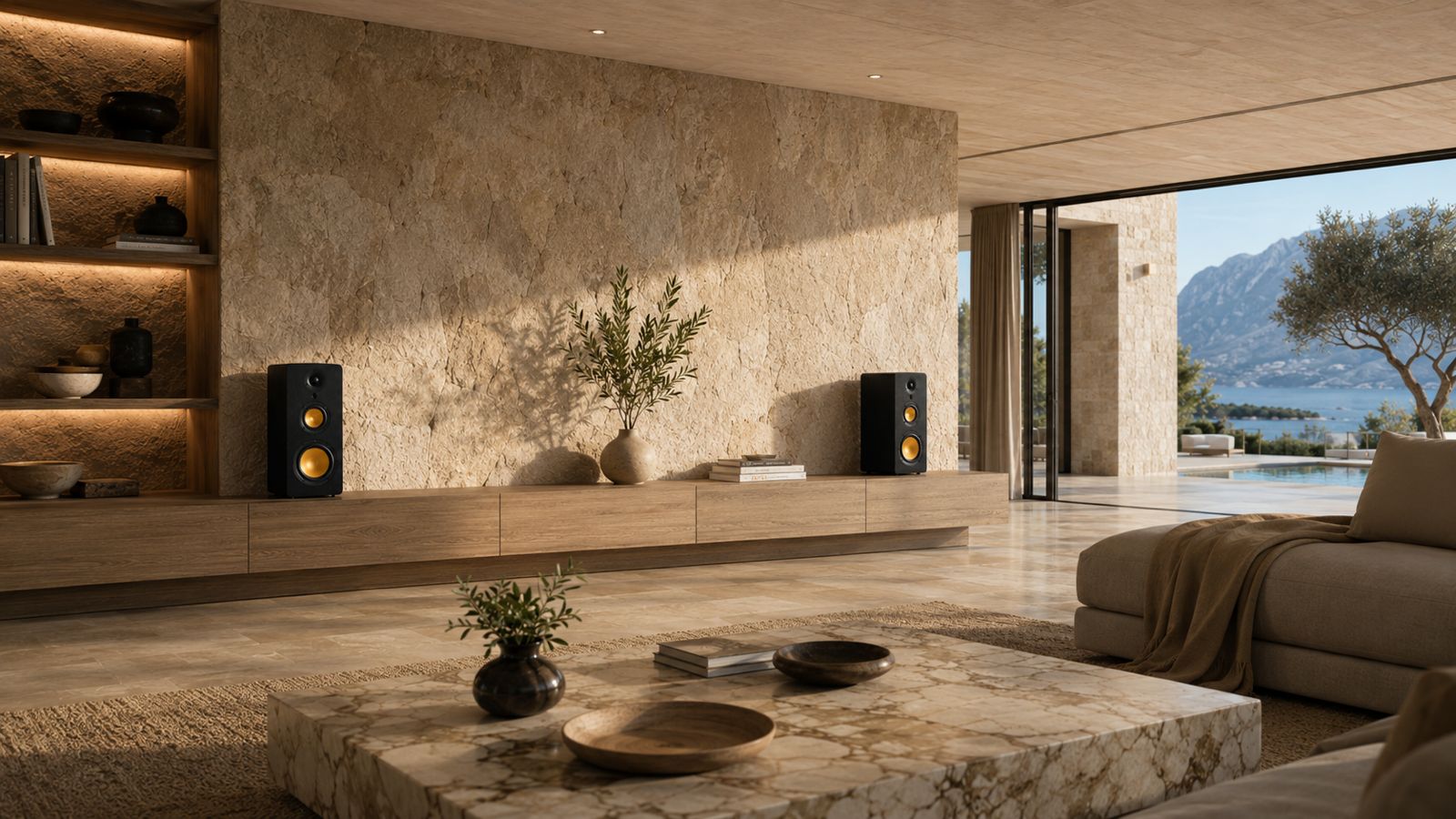

Most record players don’t have speakers of their own, so you need a separate pair. The simplest choice is a pair of powered (active) speakers, which have their amplifier built in and plug straight into the turntable. The one thing to check before you buy is where the phono stage sits: either inside the turntable, inside the speakers or amplifier, or in a small box between them. Get that right and almost any decent pair of speakers will do your records justice.
Do record players need separate speakers?
Almost all proper turntables do. A turntable is a source, like a streaming box or a CD player. It reads the groove and produces a tiny electrical signal, and something else has to amplify that signal and turn it into sound.
The exception is the all-in-one “suitcase” style player with speakers built into the case. They’re cheap and convenient, but they have real drawbacks. The speakers are small, they sit only a few centimetres apart so there’s almost no stereo effect, and they’re bolted to the same box as the stylus. Every vibration from the speakers travels back through the case into the record, which muddies the sound and, at higher volumes, can make the needle skip. If you care enough about vinyl to be reading this, separate speakers are the upgrade that makes the biggest difference.
What is a phono stage, and do you need one?
This is the part that confuses most people, and it’s behind a lot of “my record player is really quiet” searches.
The signal coming off a turntable cartridge is far weaker than the signal from a phone, a TV or a CD player. It’s also deliberately recorded with the bass cut and the treble boosted, so that the groove can physically fit on the record. A phono stage (also called a phono preamp) does two jobs: it boosts that tiny signal up to normal “line level”, and it applies the reverse equalisation, known as RIAA, so the tonal balance comes back to how it was meant to sound.
You need exactly one phono stage in the chain. It can live in one of three places:
Inside the turntable. Many modern decks have one built in, often with a switch on the back so you can turn it off.
Inside the amplifier or speakers. Some amplifiers and a few powered speakers have an input marked “Phono”.
In a separate box that sits between the turntable and your speakers or amplifier.
If there’s no phono stage anywhere, the music will be very quiet and thin, with almost no bass. If there are two, one after the other, it will be loud, harsh and distorted. So before you buy speakers, look at the back of your turntable and check whether it has a built-in preamp and a switch.
Powered, passive or Bluetooth: which speakers should you choose?
There are three sensible routes, and the right one depends on what you already own.
Powered speakers
Powered speakers have the amplifier built into the cabinet. You plug them into the mains, run a cable from the turntable’s outputs into the speakers’ input, and you’re done. If your turntable has a built-in phono stage, switch it on and connect to the speakers’ line input. For most people starting out, this is the cleanest and most affordable way to get good sound from records.
Passive speakers and an amplifier
Passive speakers have no amplifier inside, so they need a separate amplifier connected with speaker wire. This is the traditional hi-fi route. It gives you the most freedom to mix and match and upgrade one piece at a time, but it means more boxes, more cables and more decisions. If your amplifier has a phono input, switch the turntable’s own preamp off and use that input instead.
Bluetooth speakers
A Bluetooth turntable sends the music to Bluetooth speakers wirelessly, with no cable between the deck and what plays it. The trade-off is that the signal is converted to digital and compressed on the way, so a purist will tell you it’s no longer a purely analogue chain. In practice, a good Bluetooth turntable into a good pair of stereo speakers will sound far better than a suitcase player, and for many rooms the freedom to put the speakers where they sound best, rather than where the cables reach, more than makes up for it.
Why a stereo pair matters for vinyl
Nearly every record you own was mixed in stereo. The engineer placed instruments and voices across a space between two speakers, and the groove itself carries separate left and right channels. Play that through a single box and the layout collapses into one point.
This is why we’d always point you towards a pair of speakers rather than a single wireless speaker, however good it is. Two speakers, placed apart, rebuild the picture the record was made to create. We go into the reasons in more depth in why stereo still matters.
How big do the speakers need to be?
For most living rooms, bedrooms and studies, compact bookshelf speakers are the right size. They’re easy to place, they suit the scale of a turntable on a sideboard, and good ones produce plenty of bass for a normal room. Larger floorstanding speakers make sense in big, open spaces, but bigger isn’t automatically better: an oversized speaker in a small room can make bass boomy and uneven.
Placement matters more than size. Aim for the speakers to be the same distance from you as they are from each other, at roughly ear height, and try to keep them a little away from the wall. Our guide to getting a better centre image walks through the details.
Where should the speakers go in relation to the turntable?
Turntables are sensitive to vibration, because the stylus is literally reading a physical groove. If a speaker sits right next to the deck on the same shelf, its vibrations can travel back into the record. At low volume you may never notice. Turn it up, especially with plenty of bass, and you can get a low hum or boom that builds on itself, or even a skipping needle.
A few simple habits help:
Put the turntable on a solid, level surface, ideally not the same one the speakers stand on.
If they must share a surface, leave some distance and put the speakers on isolation pads or stands.
Keep the turntable away from the corners of the room, where bass is strongest.
How do you connect a record player to speakers?
It depends on the route you’ve chosen, but the order of checks is always the same:
Find out whether your turntable has a built-in phono stage, and whether it’s switched on.
Check what inputs your speakers or amplifier have: line in, phono in, or Bluetooth.
Make sure exactly one phono stage is active in the chain.
If your turntable has a thin separate earth (ground) wire, connect it to the earth terminal on your phono stage or amplifier. A missing earth connection is the most common cause of a hum or buzz.
Our own uStream TT1 is designed to cover every route. It has a built-in phono preamp you can switch off from the rear panel, RCA outputs for powered speakers or an amplifier, and Bluetooth that streams directly to any Bluetooth speaker with no receiver or phono cable. It’s a manual deck: you lift the tonearm onto the record and back to its rest yourself, and auto-stop halts the platter at the end of a side. If you’d rather not choose speakers separately at all, the uStream Groove pairs the uStream TT1 with two uStream Cube speakers, 70W RMS for the pair, and nothing to wire between them.
Frequently asked questions
Can a record player connect to any speakers?
Almost any, as long as the signal is amplified and passes through one phono stage. Powered speakers connect directly if the turntable has a built-in preamp. Passive speakers need an amplifier in between. Bluetooth speakers need a Bluetooth turntable or a Bluetooth transmitter.
Why are my record player speakers so quiet?
Usually because there’s no phono stage in the chain. The raw signal from the cartridge is very weak and bass-light without one. Check the preamp switch on the back of the turntable, or use the phono input on your amplifier if it has one.
Why are my record player speakers buzzing?
The most common cause is an unconnected earth wire between the turntable and the phono stage or amplifier. Loose cables, or cables running alongside mains leads, can also add hum. Crackling, on the other hand, usually comes from dust on the record or the stylus rather than the speakers.
Are Bluetooth record players worth it?
For most homes, yes. You give up a fully analogue signal path, but you gain freedom to place the speakers properly and lose the cables across the room. A good Bluetooth deck with a proper stereo pair of speakers will sound far better than an all-in-one player with built-in speakers.