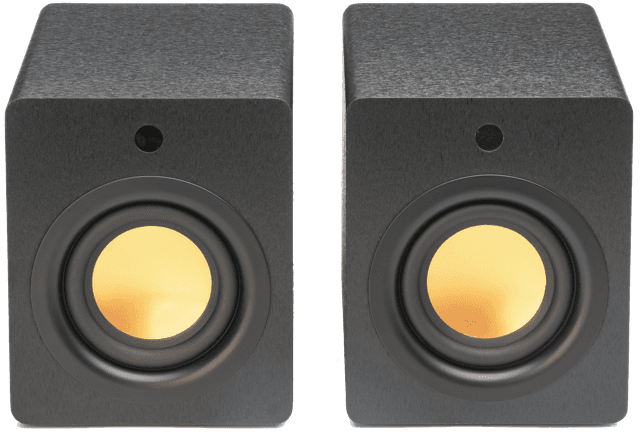

You do not always need speaker stands. What your speakers need is the right height, a solid surface and a little space from the walls. Stands are the easiest way to get all three, especially away from furniture, but a sturdy sideboard or TV unit at the right height can do the job just as well.
What do speaker stands actually do?
They raise the speakers to ear height. Tweeters send their sound in a fairly narrow beam. When they point at your ears, voices and instruments sound clearer and more detailed.
They free the speakers from walls and corners. A stand lets you place a speaker exactly where it sounds best, rather than where the furniture happens to be. Moving a speaker away from a wall usually tightens up the bass.
They give a solid, stable base. A rigid stand vibrates far less than a hollow shelf or a light table, so the cabinet is not shaking whatever it sits on.
They keep the pair symmetrical. Two matching stands make it easy to set the left and right speakers at the same height and distance.
For the full picture on positioning, our guide to where speakers should be placed is the place to start.
When is a sideboard or unit fine?
Very often. Plenty of people get excellent sound from speakers on a sideboard, a TV unit or a low cabinet. It works well when a few things are true.
The height is close to right. The tweeters should be near ear height when you are seated. A low unit may need a small angled wedge to tilt the speakers up.
The surface is solid. Heavy, well-built furniture is better than a thin panel that buzzes when the music plays.
The speakers sit near the front edge. This reduces reflections off the top of the furniture and keeps the sound open.
There is room behind them. A gap between the speaker and the wall helps the bass sound tighter, especially with rear-ported designs.
If you are working with shelves rather than a unit, our guide to how far bookshelf speakers should be from the wall covers spacing in more detail.
How high should speakers be?
A good rule of thumb is to have the tweeters roughly at ear height when you are sitting in your usual seat. Measure from the floor to your ears while sitting, and use that as your target.
If the speakers have to sit higher, such as on a tall unit, angle them down slightly towards you. If they sit lower, angle them up. The aim is the same either way: point the tweeters at your ears. A slight inward angle towards the listening position also helps the centre image hold together. Our article on getting a solid centre image explains why.
Do decoupling pads help?
They can, especially on furniture. Decoupling pads, rubber feet or small isolation platforms sit between the speaker and the surface. They reduce the vibration passed from the cabinet into a shelf or unit, which can cut buzzing and make bass sound cleaner. Some pads are angled, so they also tilt the speakers towards your ears. They are an easy thing to try before buying stands.
Are speaker stands worth it?
They are worth it if your speakers have nowhere good to go. If the only options are a low coffee table, a floor corner or a crowded shelf, a pair of stands can make a clear difference. They are also worth it if you want the speakers well away from the walls in a dedicated listening area.
If you already have a solid unit at roughly the right height, stands may add little. Try the speakers where they are, adjust the angle and distance, and listen.
Are speaker stands safe?
Stability matters, especially in homes with children or pets. Choose stands with a wide, heavy base, and check they are rated for the weight of your speakers. Some stands can be filled with sand or other material to add weight and reduce vibration. Use floor spikes on carpet, or protective cups on wood or tile, so the stands sit firmly without damaging the floor.
How do uStream speakers fit on stands or furniture?
The uStream Cube speakers connect to each other wirelessly, with no cable between them, so each one can go wherever it sounds best, on its own stand or either side of a TV on a unit. On uStream Three and uStream Two the inputs sit on the left speaker, so your source connects to that side only. uStream Three, uStream Two, uStream One and uStream Cube all connect to a TV through HDMI eARC.
Frequently asked questions
Do bookshelf speakers need stands?
Not always. They need to sit at roughly ear height on a solid surface, with some space from the wall. Stands are the simplest way to get that, but good furniture can work too.
What height should speaker stands be?
Pick a height that puts the tweeters close to your ear height when seated. Measure from the floor to your ears in your usual seat, then allow for the speaker’s own height.
Can I put speakers on furniture?
Yes, if the furniture is solid, the speakers are near the front edge and the tweeters point roughly at your ears. Decoupling pads can help.
Are speaker stands worth it?
They are worth it when your speakers have no good place to go, or when you want them clear of walls. If you already have a solid unit at the right height, they may add little.
Follow Mitchell Acoustics on Facebook, Instagram, YouTube, X, Threads, Pinterest, LinkedIn and TikTok for new uStream guides, setup films and listening tips.