
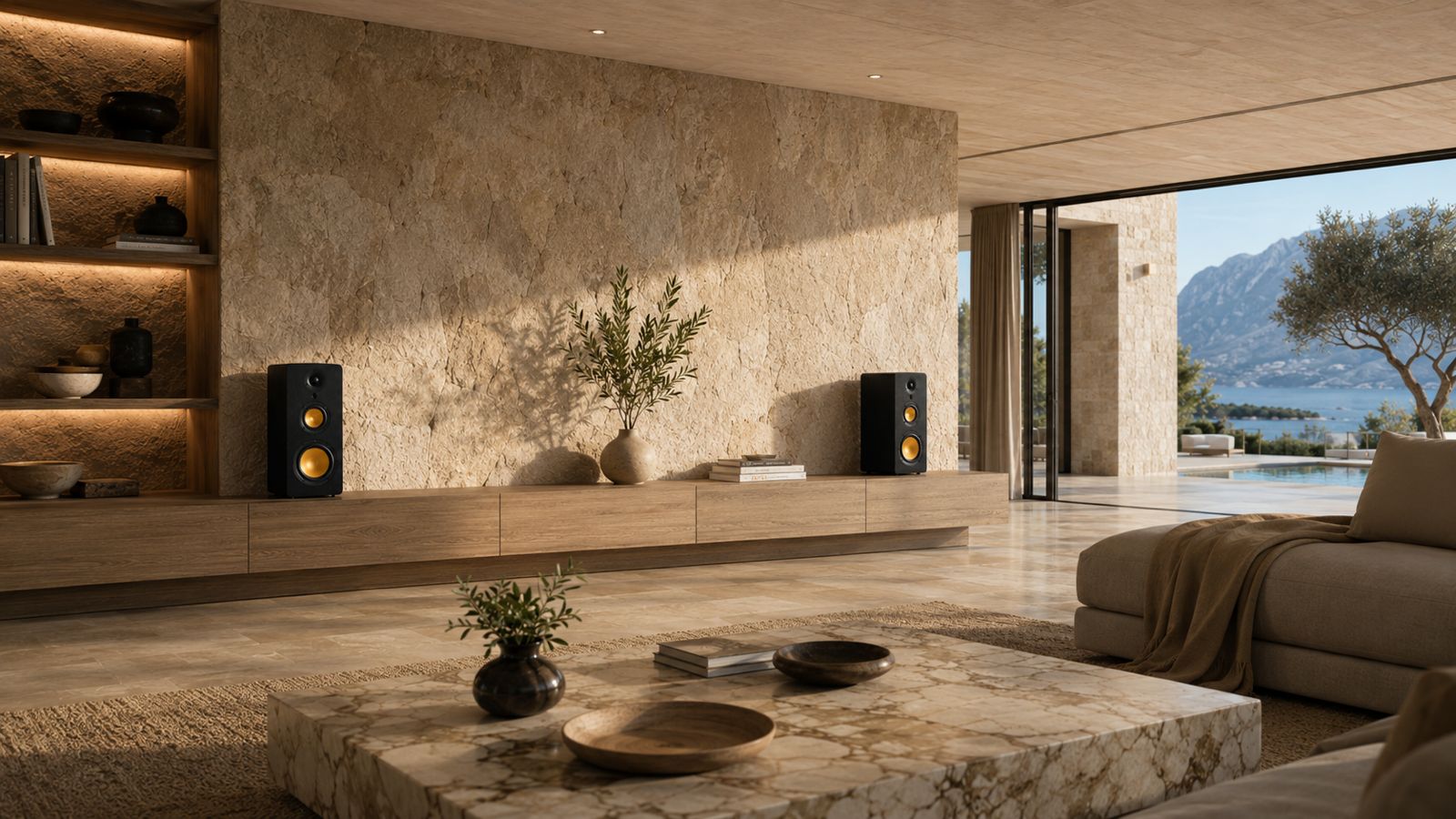
Yes, a pair of stereo speakers can replace a soundbar for TV, and for most living rooms it will sound better doing it. The catch isn’t sound quality, it’s practicality: you need a way to get audio out of the TV and into two speakers instead of one box, and you need to accept that dialogue will sit in the room rather than beam from a single strip under the screen. Once those two things are sorted, a stereo pair is the more capable option in almost every way that matters.
What does a soundbar actually give up?
A soundbar packs several small drivers into one cabinet, usually angled and processed to fake a sense of width. It’s a clever compromise, built to sit under a TV without anyone having to think about speaker placement. But it’s still one box. The left and right channels of whatever you’re watching, recorded to sit apart, get squeezed back together before they reach your ears.
Two separate speakers don’t have that problem. Left and right come from physically different points in the room, so the separation in the mix survives instead of collapsing into what we’ve called a single horizontal smear. We’ve gone through the full case for this in our soundbar vs stereo speakers comparison, including why RMS power ratings matter more than the peak-watt numbers most soundbar boxes lead with. Worth reading in full if you want the detailed version; this article is about the practical side of actually making the switch.
Will dialogue still be clear?
This is the real question behind most soundbar purchases, and it’s a fair one. Soundbars are engineered hard for dialogue, because a mumbly TV is the single biggest complaint people have about built-in TV speakers.
A stereo pair can do dialogue justice, but the mechanism is different. Instead of a dedicated centre channel, dialogue in a stereo mix usually sits equally in both the left and right signal, so it appears to come from the middle, in the gap between your two speakers. That only works cleanly if the speakers are reasonably close to the TV and roughly equal distance from your seat. Push them too far apart, or sit well off to one side, and dialogue can start to smear or thin out. Keep the setup roughly symmetrical either side of the screen and this stops being an issue. The same placement logic we cover for music in listening room design applies here too.
How do you actually connect stereo speakers to a TV?
This is the part a soundbar makes trivially easy, and it’s the part most people underestimate with a stereo pair.
Most modern TVs offer at least one of these:
HDMI ARC or eARC, which sends TV audio back down an HDMI cable to a connected device. This is the cleanest route if your speakers or their amplifier support it.
Optical (TOSLINK) output, an older but still common digital audio out, present on most sets from the last decade.
Bluetooth, which many TVs now support directly for audio out, though the connection method varies by manufacturer.
A standard headphone or line-out socket, the simplest fallback if nothing else lines up.
A wireless stereo pair simplifies the cable side considerably, because there’s no cable running between the left and right speaker. Every uStream speaker links left and right over Bluetooth and True Wireless Stereo, so once one speaker is paired to the TV, the room only has one cable to hide, not two. You still need to pick a connection method the TV actually supports, so it’s worth checking the ports on the back before you buy anything.
Do you need to spend more than a soundbar costs?
Not necessarily. Soundbars range from budget boxes to expensive multi-driver systems, and stereo speakers cover the same span. The uStream Cube, at 70W RMS, is built specifically to sit either side of a TV as a soundbar alternative rather than a full hi-fi system, so it’s a fair comparison point on price and footprint rather than a step up to something larger. If the room is bigger, or you want more headroom for music as well as TV, something like the uStream One at 100W RMS gives more scale without changing how any of this works.
Browse the full uStream range if you want to compare sizes side by side. The number worth checking on any soundbar or speaker is whether the wattage quoted is RMS or peak. RMS is what the speaker can sustain continuously; peak is a brief maximum that some marketing leans on because it’s a bigger number. A speaker rated at a huge peak figure can still be modest on continuous power, so RMS is the number that tells you how it will actually perform through a two-hour film.
What about surround sound?
A stereo pair gives you genuine left/right separation, which is more than most soundbars manage on their own, but it isn’t surround sound in the strict sense. Surround formats put some channels behind you; a stereo pair, wherever you place it, keeps everything in front. If wraparound effects for action films matter more to you than getting music and dialogue right, that’s a different setup entirely, built around multiple speakers and a receiver rather than a stereo pair. For television and everyday viewing, most people find the front-facing width and clarity of a proper stereo pair more useful day to day than occasional surround effects.
Is it worth switching?
If you already lean towards two speakers rather than one box, for the sound and for the fact you’ll use the same pair for music, the switch is straightforward. Sort the connection method first, keep the speakers roughly either side of the TV and roughly equidistant from your seat, and the rest looks after itself. If you mainly want the easiest possible box with the least thought required, a soundbar remains the simpler buy. Both are valid choices; they just solve slightly different problems. The one thing worth avoiding is assuming a soundbar is the default and speakers are the upgrade path, or the other way round. Check what your TV can actually output, check the room you’re placing speakers in, and let those two things decide it rather than habit.
Frequently asked questions
Can I connect stereo speakers directly to my TV?
Usually, yes, through HDMI ARC/eARC, optical out, Bluetooth, or a headphone/line-out socket, depending on what your TV offers. Check the back panel of the TV before buying speakers, since the connection method affects what you can pair with.
Do I need a soundbar if I already have speakers?
No. If you have a stereo pair, or you’re choosing between the two, a pair of speakers set up either side of the TV does the same job as a soundbar and, in most rooms, adds genuine stereo separation a single box can’t match.
Why are soundbars so popular if speakers can sound better?
Convenience. A soundbar is one box, one cable, no placement decisions, and dialogue is engineered hard for clarity out of the box. Stereo speakers ask a little more of the room and the setup, in exchange for real left/right separation.
Will stereo speakers give me surround sound?
No. A stereo pair improves front-facing width and separation but doesn’t add rear or side channels. True surround needs a multi-speaker system built for it, not a stereo pair, however good.

