The label is a description, not a guarantee. Speakers are hi-fi when they reproduce a recording faithfully: the sound that comes out is as close as possible to what went in, without colour, noise or distortion of their own. You cannot see that on a box, but you can check it, and the checks are the same every time: how evenly they play across the range, how little they distort, how quiet they are underneath the music, and how well the amplification is matched to the drivers.
What does hi-fi actually mean?
Hi-fi is short for high fidelity, and fidelity means faithfulness. A speaker’s job is to be a window onto the recording, not a flavour added to it. That is a goal rather than a standard, so a small desk speaker and a large floorstanding pair can both be sold as hi-fi.
What do the numbers on a spec sheet tell you?
Three figures are worth reading, and each has something it leaves out.
Frequency response is the span from the lowest to the highest note the speaker plays. A wider span can mean fuller bass and more air at the top, but the range alone does not tell you how evenly the speaker plays within it.
Distortion (THD) is the unwanted sound the speaker adds. Lower is better, and a fair figure is always quoted at a stated level and frequency, so look for both.
Signal-to-noise ratio (SNR) is how far the music sits above the background hiss. Higher means quieter pauses between notes.
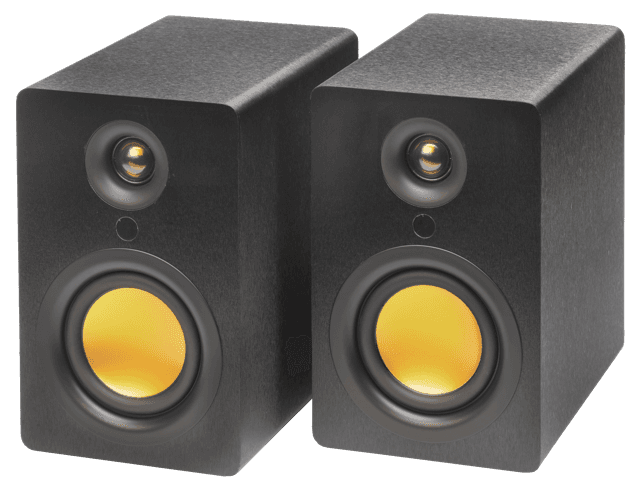
As an example, the uStream Three lists a frequency response of 30Hz to 20kHz, distortion under 1% at 1W and 1kHz, and a signal-to-noise ratio above 80dB. Power is the other number on every sheet. We only ever quote RMS, as our guide to RMS vs peak watts explains.
Why do the drivers and amplification matter?
The drivers are the parts that move the air. A tweeter handles the high notes, a woofer the low ones, and a mid driver the range where voices live, so each driver stays in the range where it is most comfortable.
The uStream Three is built that way: a 76mm silk film treble driver, a 120mm ceramic aluminium mid driver and a 165mm ceramic aluminium bass driver. Each driver has its own Texas Instruments amplifier, so every amplifier is matched to a single job. That is the advantage of an active design, where the amplification lives inside the speaker. We cover it in our guide to powered vs passive speakers.
Do the cabinet and the room matter as much as the speaker?
They matter more than most people expect. A cabinet should be rigid, so its panels do not add a sound of their own, and the speaker should be placed so the room helps it. A very good speaker in a bad position can lose to a modest one placed well. Our article on where speakers should be placed covers the starting point.
Hi-fi music is normally stereo: two channels, left and right, one for each speaker. A single box cannot recreate the separation in a recording, which is why we spend time on stereo vs mono speakers.
Can wireless speakers be hi-fi?
Yes, with one honest caveat. Bluetooth compresses the signal to fit through the wireless link, so a cable is the purer path. For most listening, the speakers and their position make a far bigger difference than the link does.
The uStream Three takes HDMI ARC, optical, RCA and 3.5mm inputs, plus Bluetooth 5.3, so you can use whichever suits the source. Every uStream pair links automatically with no app and no Wi-Fi, and there is no wire between the speakers, so you can place them where they sound best.
Do hi-fi speakers need special cables?
Not in the way the shop shelves suggest. A speaker cable carries the signal from amplifier to speaker. Choose a sensible thickness for the length, make firm connections, and you have done what a cable can do. For most listeners, spending more on cable gains far less than better speakers or better placement.
With an active speaker the question mostly disappears. The amplifier is already inside the cabinet, so there is no speaker cable to choose.
How can you tell by listening?
Play a recording you know well, at a modest volume, in the room where the speakers will live. Listen for:
Voices that sound like a person in the room, not a person in a box.
Bass that is tuneful and defined rather than boomy.
Quiet passages with no hiss or hum in the background.
Louder passages that stay clean instead of turning harsh.
Frequently asked questions
What does hi-fi mean on speakers?
It means high fidelity: reproducing a recording as faithfully as possible. Judge speakers on their performance and how they sound to you, not on the label.
Are hi-fi speakers worth it?
If you care about music or film, a good pair is one of the most noticeable upgrades over built-in TV speakers. The value is in the speakers and their placement, not extras around them.
Are active hi-fi speakers better than passive ones?
Neither is better by default. An active speaker has its amplifier built in and matched to its drivers. A passive speaker needs a separate amplifier, which lets you choose and change it.
Can hi-fi speakers be wireless or Bluetooth?
Yes. Bluetooth is convenient and good enough for most listening, and a wired input is there when you want the purest path.