Mono sends one signal to every speaker, so everything you hear comes from a single point, or from several speakers all playing exactly the same thing. Stereo sends two different signals, left and right, so instruments and voices can sit in different places across the room. For music, film and TV, stereo is almost always the better choice, because that is how nearly everything is made. Mono still has its uses, and a few recordings sound best that way.
What is the difference between mono and stereo?
The difference is the number of channels. A mono signal has one. A stereo signal has two: one for the left speaker and one for the right.
Because the two channels are not identical, they can carry different information. A guitar can sit on the left, a piano on the right, and a singer in the middle where both speakers share the sound equally. In mono, all of those things are squeezed onto the same line. You still hear them, but they stack on top of each other instead of spreading out.
It helps to separate two things that people often mix up:
Mono or stereo content. This is the recording or the broadcast itself. Is there a left and a right channel in the file?
Mono or stereo playback. This is what your speakers do with it. A stereo recording played through one speaker is heard in mono, because a single speaker has only one place to put the sound.
You need both halves for stereo to work. A stereo recording on one speaker is mono. A mono recording on two speakers is still mono, just from two places.
Why does stereo sound wider?
Your two ears work together to tell you where a sound is. A sound from your left reaches your left ear slightly earlier and slightly louder than your right. Your brain uses those small differences to place the source.
Two speakers recreate that. When the left speaker plays a little more of the guitar and the right plays a little less, your brain places the guitar towards the left. When both speakers play the singer at the same level, you hear the voice floating in the gap between them, even though nothing is there. We explain that effect in more depth in why stereo still matters.
A single speaker has no way to do this. However good it is, everything comes from one spot, so the sense of width and depth is gone. That is the real cost of mono: not volume, and not necessarily tone, but space.
Is mono sound ever better than stereo?
Sometimes, in specific cases.
Older recordings. In the early days of pop music, many records were made with mono as the main version, and some engineers put their effort into the mono mix. If a record was designed to be heard in mono, hearing it that way can be the more faithful choice.
Speech. A podcast, an audiobook or a radio talk show usually has one voice at a time, so a second channel adds very little.
A large or awkward space. In a big room with listeners spread around, such as a shop or a café, someone near one speaker of a stereo pair will hear mostly that side. Playing the same mono signal from every speaker gives everybody a similar balance.
Announcements and alerts. Where clarity matters more than atmosphere, mono is simple and dependable.
For listening at home to music, films and TV, none of these usually applies. Almost everything you play was mixed in stereo, and you lose part of it when you listen on one speaker.
What happens when you play stereo through one speaker?
Most people have done this without thinking about it. A phone, a tablet and most small smart speakers play stereo content through a single speaker, so the left and right channels are combined into one.
That combining, often called a fold-down, usually works well enough. But it can cost you something. If the two channels contain very similar sound that is slightly out of step, parts of it can partly cancel when added together, and some elements come out thinner or quieter than they should. The effect depends on the recording, and it is another reason mono playback can sound a little flatter than the same music in stereo.
Do two mono speakers make stereo?
Not on their own. Two speakers playing the same signal are still mono, only louder and from two places. To get stereo you need two speakers that each play their own channel: one left, one right.
This is where wireless speaker pairs can confuse people. Some Bluetooth speakers can be linked so that both play the same sound, which is often called party mode or similar. That fills a room with sound but does not create stereo. Others link as a true left and right pair. The label to look for is true wireless stereo, which we cover in what is True Wireless Stereo. If a pair is described as “left and right”, it is stereo. If it is described as “play on both”, it is probably mono from two places.
Stereo or mono for a TV?
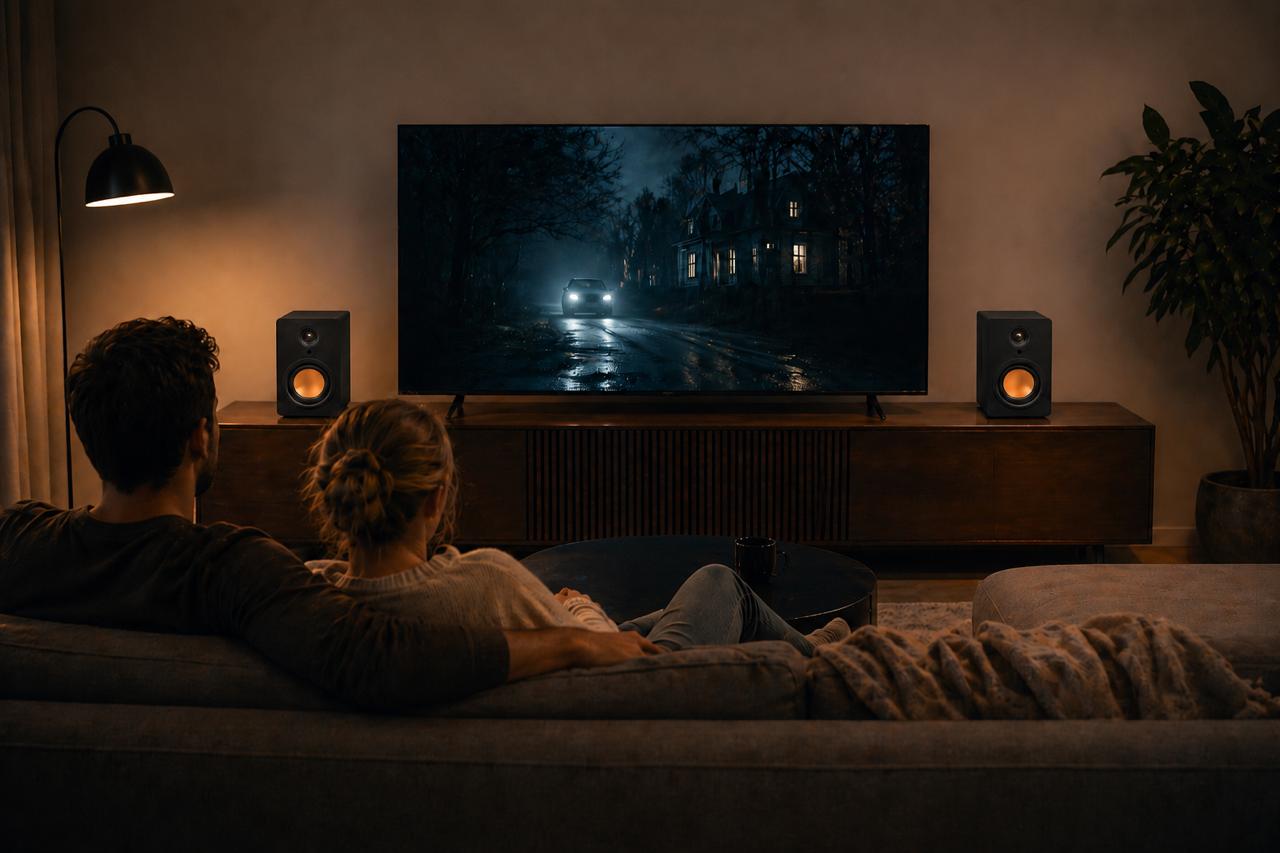
Broadcast TV, streaming services and films carry stereo or surround sound. Even a basic TV mixes this down to two channels. A single mono speaker, or a built-in TV speaker pointing forwards from a thin cabinet, cannot place a footstep on the left of the screen or a car passing from right to left. A stereo pair, set either side of the screen, can.
A pair also keeps dialogue clear. Voices sit in the middle of the picture, between the speakers, which is where your eyes expect them. If you are weighing it up, our soundbar vs stereo speakers comparison goes through the trade-offs in detail.
What about stereo vs surround?
Surround sound adds more channels, such as a centre speaker for dialogue, and rear speakers for effects. It can be impressive in a dedicated room with the right equipment, but it needs more speakers, more cables and more careful placement. In an ordinary living room, a well-placed stereo pair gives you a wide, convincing picture for much less fuss. For music, which was not made for surround in the first place, stereo is the natural fit.
How do you get proper stereo at home?
You need two things: a pair of speakers, and a setup that lets each one do its job.
Use two speakers, one for each channel. Check that your pair is a true left and right pair, not two speakers playing the same signal.
Place them apart. A good starting point is a distance between the speakers about equal to the distance from each to your seat. If your room does not allow that, where speakers should be placed covers the compromises.
Keep them at ear height. Tweeters roughly level with your ears when you are seated give the clearest sound.
Check the source. Make sure your TV or streamer is set to output stereo and that no setting is forcing mono. Some phones and devices have a mono audio option in their accessibility settings. If everything sounds oddly narrow, that is worth checking.
Wireless pairs make this much easier because there is no cable between the left and right speaker, so you can put each one exactly where it should go. The uStream Cube links its two speakers wirelessly and connects to a TV by HDMI ARC. The portable uStream Go is two speakers, left and right, that pair automatically when switched on, with no app and no cable between them, and they can be placed up to 15 feet apart.
Frequently asked questions
Is mono or stereo better for speakers?
Stereo is better for nearly everything you listen to at home, because music, films and TV are mixed in stereo and two speakers can reproduce the width and placement. Mono is better for speech-only content or for spreading identical sound around a big space.
What is the difference between mono and stereo speakers?
A mono speaker plays a single channel from one point. Stereo speakers are a pair, with one playing the left channel and the other the right, so sounds can appear in different places between them. Strictly, a speaker is not “mono” or “stereo” by itself; it is how you use it. One speaker is always mono, and two speakers can be stereo.
Is mono sound better than stereo?
Not generally. Mono can be the more faithful way to hear an older recording that was mixed for it, and it works well for speech. For most modern music and video, stereo gives a fuller and more natural result.
Can I use one stereo speaker and still get stereo?
No. One speaker can only play one point of sound, so you hear a mono version of the stereo signal. Some single speakers use processing to make the sound seem wider, but nothing matches the separation of two speakers placed apart.