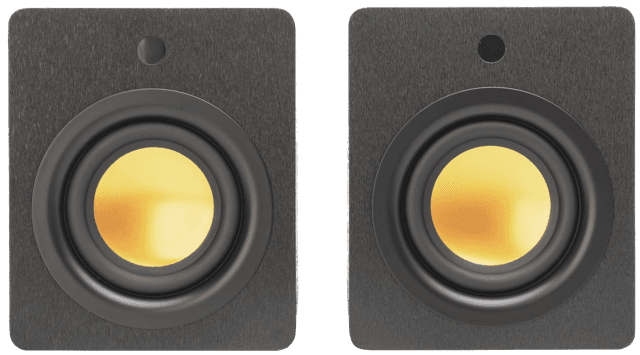

Vintage hi-fi speakers can be worth buying, as long as you know what wears out with age and you already have, or are happy to buy, an amplifier to run them. A good pair in sound condition can still give a lot of music for the money. A tired pair can need repairs that cost more than you saved. The trick is to check carefully before you hand over any money.
What wears out on old speakers?
Foam surrounds. The flexible ring that holds a woofer cone in place was often made of foam on speakers from the 1970s and 1980s. Foam breaks down over time, cracks and eventually crumbles. Rubber and treated cloth surrounds usually last much longer.
Crossover parts. Inside the cabinet, a crossover splits the signal between the drivers. Some of its components, especially electrolytic capacitors, can drift from their values over many years, which can make a speaker sound dull or uneven.
Drivers. Cones can be torn, dented or pushed in, and a voice coil can rub if the cone has shifted.
Cabinets. Veneer can lift, joints can open and grille cloth can fade or sag. A loose panel can buzz.
Terminals. Old spring clip terminals can be weak or corroded, so the speaker cable does not make a firm connection.
None of these rules a pair out. Surrounds can be replaced and crossovers serviced by a specialist, but price the work into what you pay.
How do you check vintage speakers by eye?
Take the grilles off if they come away easily, and look at each driver in good light. Check the surrounds for cracks, stiffness or crumbling. Look for tears, dents or signs of an amateur repair. Compare the two closely, because a pair should match, and a mismatched driver may be a replacement that does not suit the design.
With the speaker unconnected, gently press a woofer cone in with your fingers spread evenly around it. It should move smoothly and quietly. A scraping or gritty feel can point to a rubbing voice coil.
How do you check them by ear?
If you can, listen before you buy, using music you know well at a normal volume.
Play each speaker on its own, using the amplifier’s balance control. Both should sound the same.
Listen for buzzes, rattles or crackles, especially on bass notes and at slightly higher volume.
Check the treble. If one speaker sounds duller than the other, its tweeter may be damaged or its crossover tired.
Swap the left and right connections. If a fault moves with the speaker, the problem is in that speaker, not the amplifier.
Do vintage speakers need an amplifier?
Almost always. Most vintage hi-fi speakers are passive, which means they have no amplifier inside and need a separate amplifier and speaker cable to work. If you do not already own one, the cost and space of an amplifier is part of the real price. Check that the amplifier suits the impedance printed on the back of the speakers.
Our guide to powered vs passive speakers explains the difference in more detail, and our article on what makes speakers hi-fi covers what to listen for in any pair. If you want to stream music to an older amplifier, our guide to adding Bluetooth to an old stereo shows how.
Will vintage speakers suit a modern room?
Size matters more than many buyers expect. Some older designs are large boxes, made for rooms where a pair of speakers was the main piece of furniture. In a smaller modern living room, big cabinets can dominate the space and their bass can sound heavy or boomy, especially if they have to sit close to a wall or in a corner.
Measure the space you have before you go to see a pair, and think about where each speaker will actually stand. If you are short on space, our guide to speakers for a small room is a good place to start.
Once you have them home, a little routine care will keep them going. Our guide to caring for speakers and turntables in real homes covers dust, sunlight and placement.
When are new powered speakers the simpler choice?
Vintage speakers suit someone who enjoys the hunt, already owns an amplifier and is happy to arrange repairs. If you want music and TV sound with less to set up and nothing to restore, a new powered pair is usually simpler.
A pair of uStream speakers has the amplification built in, so there is no separate amplifier to buy. The two speakers link automatically when you switch them on, with no app and no Wi-Fi, and there is no wire between the speakers. uStream Three, uStream Two, uStream One and uStream Cube all connect to a TV through HDMI eARC, and every product comes with a 2-year no-quibble warranty.
Frequently asked questions
Are vintage speakers better than new ones?
Not automatically. Some vintage designs still sound very good, but condition matters most, so judge each pair on how it sounds and what it needs.
What should I check when buying second hand speakers?
Look at the surrounds, cones and cabinets, press the woofer cones gently to feel for rubbing, and listen to each speaker on its own for buzzes and dull treble.
Can foam surrounds be replaced?
Yes. Replacement surrounds are widely available, and a specialist repairer can fit them if you would rather not do it yourself.
Are vintage speakers good for a small room?
Smaller vintage pairs can work well. Large cabinets often struggle in a small room, because they can sound boomy close to walls and take up a lot of space.
Follow Mitchell Acoustics on Facebook, Instagram, YouTube, X, Threads, Pinterest, LinkedIn and TikTok for new uStream guides, setup films and listening tips.